






Most people who call us about a fall start by apologizing for it. They tell us they should have been looking where they were going, or that it was probably their own clumsiness, and then they ask whether there is any point in even asking. That instinct is understandable, and it is also the reason a lot of legitimate claims never get made.
Whether a property owner owes you anything comes down to two questions, and neither one is about how graceful you were. The first is what you were doing on that property. The second is whether the owner knew about the hazard, or should have known about it. We walk you through both, in plain language, so you can tell where your own situation falls.
Our slip and fall attorneys at Smith Horras, P.A. have more than 60 years of combined legal experience, with trial and appellate work on the record. Call 208-697-5555 or fill out the consultation form to tell us what happened. The consultation is free, and you pay no fee unless we recover for you.
What we bring to a premises claim:
- An Idaho family-owned injury firm serving the Treasure Valley and statewide since 2007
- Founder Bill Smith named to The National Trial Lawyers Top 100 (2025) and selected to Super Lawyers for Idaho personal injury, 2023 through 2026
- Joe Horras was prevailing counsel before the full Ninth Circuit Court of Appeals sitting en banc
- Rated 5.0 across 53 Google reviews
- Free consultations, and no attorney fee unless we recover for you
What Our Clients Say
Mr. Horras is an outstanding personal injury attorney in the 208 area. He is professional, knowledgeable, and truly committed to his clients. It’s clear he takes the time to understand each case and advocate for his clients with integrity and care.
Communication was clear and thoughtful, and his attention to detail really sets him apart. I would confidently recommend Mr. Horras to anyone in the Treasure Valley who needs strong, trustworthy injury representation.
– Jerrod Stacy, Google Review
Smith Horras Law Firm is the best law firm I’ve worked with. Bill helped me with my injury claim and I honestly couldn’t be happier with how everything turned out.
Everyone there was easy to talk to and always got back to me when I had questions. I really felt like they cared and had my back the whole time.
Definitely people I trust and would go to again if I ever need help. Highly recommend them.
– Mikhail Iyerusalimets, Google Review
Testimonials reflect individual experiences. Prior results do not guarantee a similar outcome.
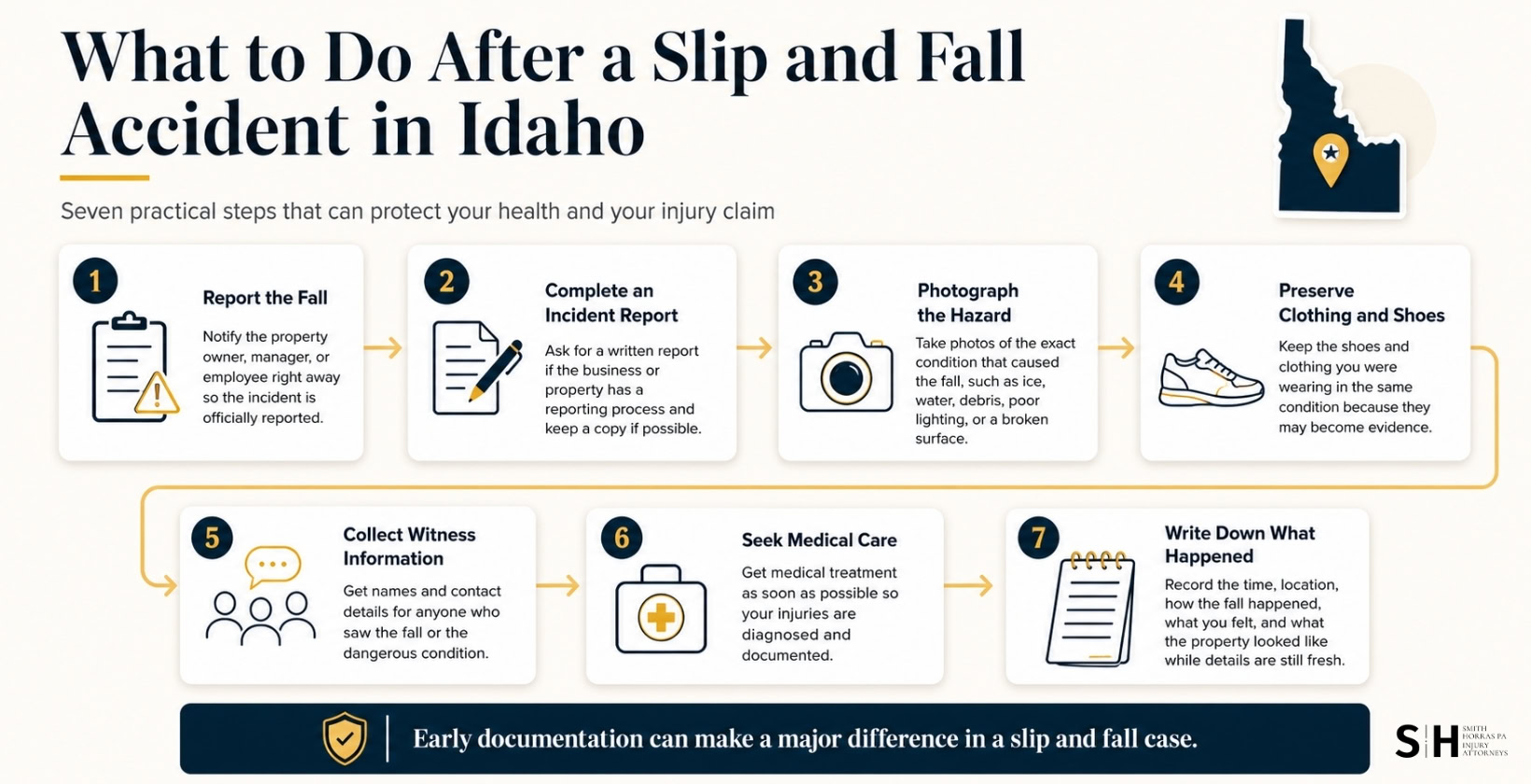
What to Do After a Slip and Fall Accident in Idaho
The first hour matters more than most people realize, because the two things that prove a fall claim, the hazard itself and the footage of it, are usually gone within days. If you are reading this after the fact, do what you still can and tell us what is missing.
- Report the fall before you leave. Ask the manager for a written incident report, and ask for a copy of it.
- Fill out their accident report, and be honest on it. It is tempting to decline, but an accurate account made at the scene corroborates the footage later. A vague or missing report helps the other side.
- Photograph the hazard before it is cleaned up, along with the lighting, the surrounding area, and anything that blocked your view.
- Keep the shoes and clothes you were wearing, unwashed. If you slipped on something that can be kept, keep that too.
- Get names and phone numbers for anyone who saw you fall.
- See a doctor promptly and describe the fall accurately. The gap between a fall and the first medical visit is the first thing an insurer will point at.
- Write down what happened while it is fresh, including the time and what you were doing there.
Surveillance is the piece that disappears first, often on a cycle measured in days. If your fall was recent, call us to tell what happened, and we can ask the property owner to preserve it before it cycles.
When Is a Property Owner Liable for Your Fall?
A premises claim is a negligence claim, so it comes down to two questions: what you were doing on the property, which sets how much care you were owed, and whether the owner knew about the hazard or should have known. Idaho’s baseline is that an owner or occupier owes a duty of ordinary care to avoid exposing people on the premises to an unreasonable risk of harm.
| Where You Were, and Why | Your Legal Status | What the Owner Owed You |
|---|---|---|
| On the property for a purpose connected with the business there, such as shopping, dining, or a hotel stay | Invitee | Ordinary care throughout the areas you could reasonably be expected to go |
| There for your own purposes, such as visiting as a dinner guest | Licensee (a social guest is a licensee) | A warning about dangers the owner knew of that you could not reasonably have discovered |
| There without permission, invitation, or lawful authority | Trespasser | No duty if your presence was unknown; once known or anticipated, a duty not to injure you intentionally or recklessly |
Invitee is the strongest position and covers most of the falls we see. A social guest is a licensee, not an invitee, and doing a small favor for the host does not change that. Status can also narrow if you enter an area customers are not meant to go.
On the second question, knowledge can be actual, where someone saw it and did nothing; constructive, where the hazard sat long enough that a careful owner inspecting the property would have found it; or imputed, the most powerful, where an employee created or knew about the hazard and the owner is deemed to have known as a matter of law. That is why the proof is documentary: sweep and inspection logs, surveillance that is usually overwritten within days, incident reports, and employee statements.
If you fell in an Idaho business and are not sure whether anyone knew about the hazard, that is exactly what we can find out. Tell us what happened and we will look into it at no cost to you.Call 208-697-5555 Now. |
Common Types of Idaho Slip and Fall Accidents
Falls happen in a small number of recognizable ways, and knowing which one describes yours tells you where the proof will come from:
- Ice and snow on sidewalks, parking lots, entryways, and unsalted steps. The question is rarely whether ice is dangerous but whether the owner had a reasonable opportunity to deal with it, so snow left from overnight is a very different case from ice that formed minutes earlier. Photograph it quickly, because the evidence melts.
- Wet and slippery floors from spills, tracked-in rain, restroom leaks, or cleaning without a warning cone. Sweep logs and surveillance decide these, because the whole dispute is how long the water was on the floor before you stepped in it.
- Stairs, handrails, and building defects, including loose or missing handrails, uneven treads, poor lighting, torn carpet, and broken pavement. Building codes set measurable requirements for things like handrail placement and stair dimensions, and a property that does not meet the one that applies to it is powerful evidence the owner fell short.

How We Prove an Idaho Slip and Fall Claim
To prove a slip and fall case in Idaho, four things have to come together:
- You were owed a duty,
- The owner failed to meet it,
- The failure caused your injury, and
- The injury cost you something real
The first two come from your status on the property and what the owner knew or should have known. The last two come from evidence, and that is where we add speed and leverage on records you cannot get yourself. We request surveillance before it cycles, ask for sweep and inspection logs, identify which employees were working that shift, and deal with the insurer so you are not negotiating while you are still treating. For more, see whether the insurance company’s offer is enough and what not to say to an insurance adjuster.
What You Can Recover After a Fall in Idaho
What a claim is worth follows from what the fall actually did to you. Falls produce a particular pattern of harm: fractures, especially wrists and hips, where a single fall can permanently change how independently someone lives; head injuries from concussion to lasting difficulty; back and spine injuries; and torn ligaments that often need surgery.
Depending on the severity of the injuries and their impact on your life, economic damages cover treatment, future care, lost wages, and reduced earning capacity. Non-economic damages cover pain, emotional distress, loss of enjoyment and permanent scarring.
One Idaho rule shapes the second list: Idaho Code § 6-1603 caps non-economic damages at an amount recalculated every July 1, never touches your economic damages, and lifts where the conduct was willful or reckless, or where the trier of fact finds beyond a reasonable doubt the act would constitute a felony.
For a fuller picture, see what an injury claim is worth and the types of damages you can claim.
The Idaho Laws That Decide a Slip and Fall Claim
Four Idaho rules do most of the work in a premises case, and one of them can end a claim before it starts.
The Two-Year Filing Deadline
Idaho Code § 5-219(4) gives you two years from the date of the fall to file a personal injury lawsuit. It runs from the day you fell, not from the day you understood how badly you were hurt, and Idaho does not offer a general discovery-rule extension. The statute says plainly that the period is not extended by continuing consequences or damages.
The 180-Day Rule for Government Property
This is the rule that catches people, and it catches them permanently. A fall at a city library, a public park, a county building, a school, or a state facility falls under the Idaho Tort Claims Act, which requires a written notice of claim within 180 days. For a claim against the State, that notice goes to the Secretary of State. For a claim against a city, county, school district or similar entity, it goes to the clerk or secretary of that entity. Miss it, and the statute is unforgiving: no claim or action is allowed. Claims against government entities are also subject to a $500,000 aggregate cap that includes costs and fees.
If there is any chance the property was publicly owned, that is worth a phone call this week rather than next month. Call us to find out whether a public entity is involved.
Comparative Fault and Your Claim
Idaho follows modified comparative negligence under Idaho Code § 6-801. You can recover as long as your share of the fault is not as great as the property owner’s, and your damages are reduced by your percentage. At exactly 50%, you recover nothing. So if a jury put your damages at $100,000 and found you 25 percent responsible, you would recover $75,000. Where more than one party is involved, a store, a cleaning contractor, and a maintenance company, for instance, Idaho compares your fault against each of them individually rather than against all of them combined.
Recreational Land Use Protection
Idaho Code § 36-1604 gives a landowner who opens property for recreational use no duty of care to keep the land safe or to warn of dangerous conditions, and says that letting people in for recreation does not make them invitees or licensees. It is a broad protection, and Idaho has a great deal of land it applies to. It does not, however, protect anyone who charges for the use.
Where We Handle Idaho Slip and Fall Claims
Our office is at 5561 N. Glenwood Street in Garden City, and our personal injury attorneys take premises cases across the Treasure Valley and throughout the state.
- Garden City, Boise, Meridian, Eagle, Kuna, and Star are in Ada County, which sits in Idaho’s Fourth Judicial District. The Ada County Courthouse is at 200 West Front Street in Boise
- Nampa and Caldwell are in Canyon County, which sits in Idaho’s Third Judicial District. The Canyon County Courthouse is at 1115 Albany Street in Caldwell
- We also represent people injured in Mountain Home, Twin Falls, Idaho Falls, Pocatello, Coeur d’Alene, Lewiston, and communities across Idaho
If you are not sure which county your fall happened in, tell us where it was and we will sort that out. See our full Idaho injury practice areas.
Idaho Slip and Fall Questions
Can You File a Claim for a Fall Caused by Snow or Ice in Idaho?
Often, yes. The question is not whether ice is dangerous but whether the property owner had a reasonable opportunity to clear it and failed to. Snow that fell overnight and was still there the following afternoon is a very different case from ice that formed minutes before you arrived.
Can I Still Claim if They Say I Wasn’t Watching Where I Was Going?
Usually yes. That is the first argument almost every insurer makes, and Idaho law does not treat it as an automatic answer. Under Idaho’s comparative negligence rule, you can still recover as long as your share of the fault is less than the property owner’s, with your damages reduced by your percentage. Holding your share to what the facts actually support is a large part of our job.
Who Can File a Claim if a Fall Was Fatal?
Under Idaho Code § 5-311, a wrongful death claim belongs to the person’s heirs or to their personal representative. You do not have to be appointed the estate’s representative to have that right. Idaho also reads “heirs” broadly, reaching a spouse, children, stepchildren, and parents, and in some circumstances dependent relatives.
What Does It Cost to Hire an Idaho Slip and Fall Lawyer?
Generally, it costs nothing up front to hire a slip and fall lawyer in Idaho. We work on contingency, so you pay no attorney fee unless we recover for you, and the consultation is free.
What if I Did Not Report the Fall the Day It Happened?
It makes the case harder, not impossible. A late report gives the other side an argument, but it can be met with medical records, witness accounts, photographs, and sometimes surveillance. Tell us what you do have.
Does It Matter That I Did Not See a Doctor Right Away?
It matters, because the gap becomes the insurer’s argument that you were not really hurt. It is not fatal to a claim. Adrenaline masks injuries, and some, particularly to the back and head, take days to declare themselves. Get treatment now and be accurate with your doctor about when the pain started.
What if I Fell at Work?
If you fell at work, workers’ compensation is usually your route against your employer, and Idaho makes that remedy exclusive. But if someone other than your employer contributed to the fall, a property owner, a contractor, a maintenance company, Idaho law preserves a separate claim against that third party. Both can run at once, and the second one is the part people miss.
How Long Do Slip and Fall Cases Take?
It depends on the severity of the injury and whether the property owner disputes responsibility. The biggest factor is your own treatment, because a claim should not resolve until your doctors know what your recovery looks like. We will give you a realistic timeline at the first consultation.
Talk to an Idaho Slip and Fall Lawyer
If you are still not sure whether what happened to you is worth pursuing, that is a good enough reason to call. We will tell you honestly what we think, including when we think there is not much there.
Call 208-697-5555 or request your free consultation. We answer 24/7, and there is no fee unless we recover for you.