




Nothing about the first week after a serious injury goes the way you’d expect. There’s pain to manage, work you can’t get to, bills that show up before treatment wraps up, and an adjuster calling with questions that sound friendlier than they are.
Idaho treats a car crash on Chinden Boulevard, a fall at a Boise apartment complex, or a dog bite the same way: one fault and negligence framework, valued by what the injury actually cost you. We handle the insurer directly, lock down evidence while it’s still there, and build every file as if it’s going to trial, because that’s the only way to negotiate one that doesn’t.
Call (208) 697-5555 and tell us what happened. There’s no cost for that conversation, and no fee unless the case wins.
What sets this firm apart for injured clients in the area:
- Local and family-owned since 2007: Founded by William “Bill” Smith, based in Garden City since 2009, and still locally owned.
- 60+ years of combined Idaho legal experience: Spread across three partners who have spent their careers in Idaho courtrooms.
- Recognized legal credentials: William L. Smith has been selected to Super Lawyers, Idaho Personal Injury (2023–2026) and The National Trial Lawyers Top 100 (2025).
- Contingency-only billing: Case costs get covered upfront, and a fee only comes out of an actual recovery.
- 24/7 intake: Serious injuries do not keep business hours, and neither does our intake team.
- Five-star reputation: A 5.0 rating built from 53 Google reviews, and a 4.7 out of 5 across 87 aggregated reviews on Birdeye.
Call us or visit our Garden City office at 5561 N Glenwood St, Garden City, ID 83714 to discuss your legal options during a free consultation.
Hear What Our Clients Have to Say
I would confidently recommend Mr. Horras
Mr. Horras is an outstanding personal injury attorney in the 208 area. He is professional, knowledgeable, and truly committed to his clients. It’s clear he takes the time to understand each case and advocate for his clients with integrity and care. Communication was clear and thoughtful, and his attention to detail really sets him apart. I would confidently recommend Mr. Horras to anyone in the Treasure Valley who needs strong, trustworthy injury representation.
Personal Injury Client
Client stories are one way to know we deliver. The clearer test is whether Idaho law actually supports a claim in your situation. Get a free case review, and we’ll walk you through it, or keep reading to see how Idaho defines a valid claim.
Do You Have a Personal Injury Claim in Boise, Idaho?
Idaho negligence law comes down to four elements: the other party owed you a duty, they breached it, that breach caused your injury, and you have damages as a result. If a driver, property owner, or dog owner failed to act reasonably and you got hurt because of it, you likely clear all four.
Every case still turns on its own facts, which is why a personal injury attorney’s role starts with an honest look at whether yours does. Most personal injury lawsuits in this area, including car accident, premises liability, and dog bite claims, are filed at the Ada County Courthouse in Boise, part of Idaho’s Fourth Judicial District. Which court matters less than what kind of claim you have, and that depends on what actually happened.
What Type of Personal Injury Case Do You Have?
The right approach to a claim depends entirely on how the injury happened, so here’s the range of personal injury claims we handle across Garden City, Boise, Meridian, Eagle, Nampa, and Caldwell, covering everything from car accidents to premises liability across our full range of practice areas, including crashes on I-84, Chinden Boulevard, State Highway 44, and Eagle Road.
Car accidents make up most of what comes through the door, and they raise a question almost every client asks at some point: what if the accident was partly my fault?
What If You Were Partly at Fault for Your Injury?
Idaho follows modified comparative negligence under Idaho Code § 6-801. You can still recover as long as you’re less than 50% at fault. Your award gets reduced by your percentage of fault, and you recover nothing if you’re found 50% or more at fault.
Here’s what that looks like with real numbers: $100,000 in damages, 20% at fault, and you recover $80,000. Push that to 55% at fault, and the recovery drops to zero. When more than one party contributed to the crash, fault gets compared against each of them individually, not lumped together.
Fault affects how much you recover. What you’re recovering for, the actual damages, is the next thing worth understanding.
What Is Your Personal Injury Claim Worth in Boise, Idaho?
Idaho law allows injured people to recover for measurable financial losses and for the personal toll an injury takes. What applies to your case depends on its facts, its evidence, and how serious the injury turned out to be.
Economic Damages
These are the losses with a receipt or a paystub behind them.
- Medical expenses: Emergency care, hospital stays, surgeries, medications, and rehabilitation.
- Lost income: Missed wages, lost benefits, and reduced earning capacity going forward.
- Future medical care: Ongoing treatment, physical therapy, and long-term health needs.
- Property and out-of-pocket costs: Vehicle repairs, transportation, and home modifications.
Non-Economic Damages
These cover pain and suffering, emotional distress, loss of enjoyment of life, and loss of companionship, and Idaho caps them under Idaho Code § 6-1603. The cap started at $250,000 and adjusts every July 1 based on Idaho’s average annual wage, as calculated by the Idaho Industrial Commission. As of July 1, 2026, it sits at $538,425.04 per claimant. It doesn’t apply if your injury resulted from willful or reckless misconduct, or from conduct a jury finds beyond a reasonable doubt to be a felony.
Punitive Damages
Idaho Code § 6-1604 allows these only when a claimant proves, by clear and convincing evidence, that the defendant’s conduct was oppressive, fraudulent, malicious, or outrageous. Ordinary carelessness, even serious carelessness, does not meet that bar. These punish the wrongdoer. They don’t compensate your losses, so they’re calculated separately.
If an insurer knocks its offer down over alleged fault, check whether the settlement fully reflects your claim’s value before you accept it. It’s also worth reading up on what your injury case may be worth and the types of damages a personal injury attorney may help you claim. Value only matters if you file in time, though, and Idaho’s deadlines are stricter than most people assume.
Idaho Filing Deadlines You Cannot Miss
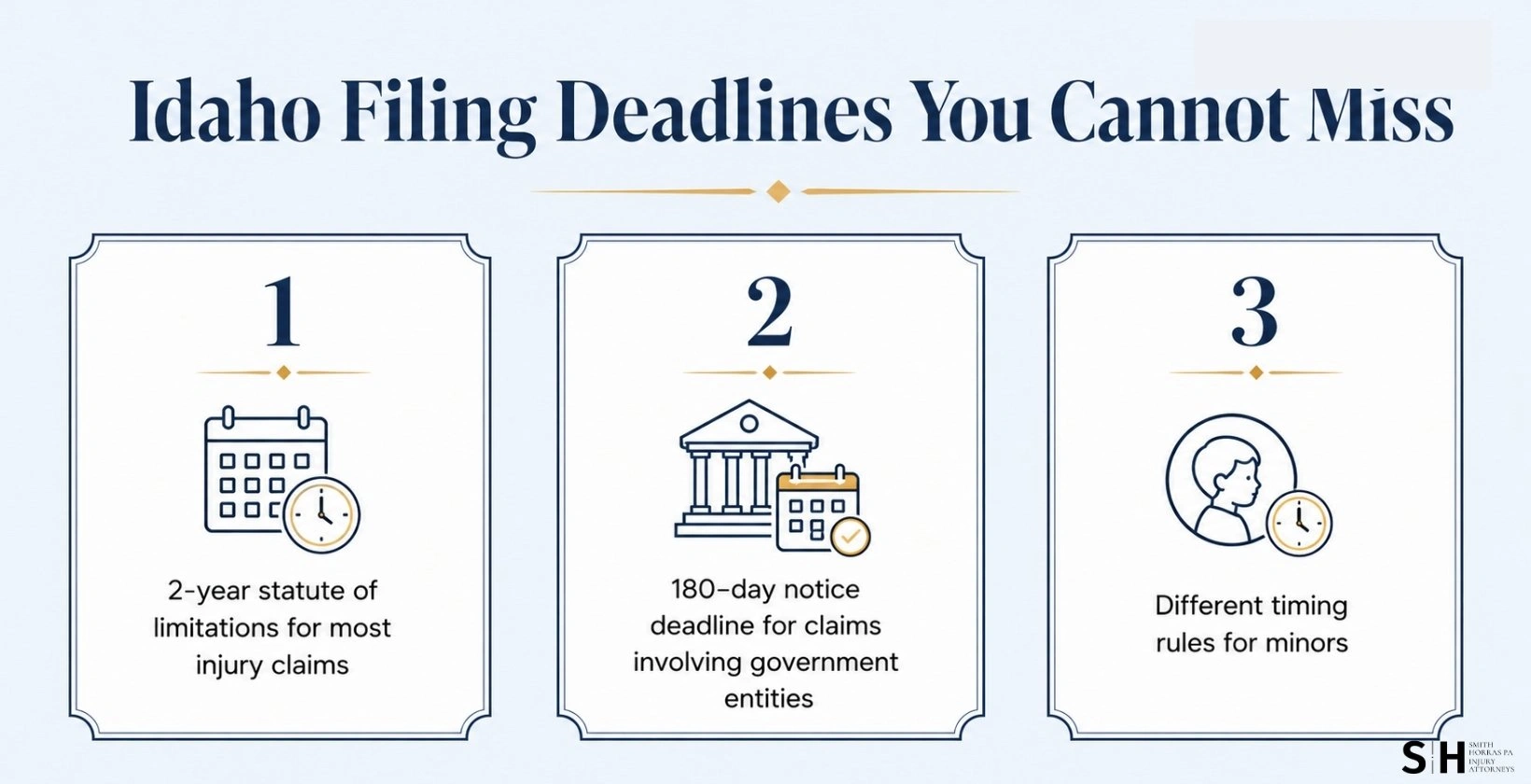
Idaho gives you a real deadline to file, and it does not bend for a good excuse.
- Two-year statute of limitations: Idaho Code § 5-219(4) gives most injured people two years from the date of injury or death to file. Courts dismiss claims filed even a day late, regardless of how strong the evidence is.
- 180-day government notice: Idaho Code § 6-905 requires written notice to a government agency within 180 days when a government employee or entity caused the injury, far shorter than the standard two-year window. Miss it, and the claim against that agency is gone.
- Minors: Idaho generally tolls the statute of limitations until an injured child turns 18, which extends the filing window well past the usual two years.
Personal injury lawsuits here are generally filed at the Ada County Courthouse, 200 W. Front St., Boise, ID 83702, part of Idaho’s Fourth Judicial District. Deadlines protect your right to file. What happens once the insurance company gets involved is a separate fight entirely.
How Insurance Companies Try to Limit Your Boise Claim
Idaho’s financial-responsibility law sets minimum auto liability coverage at $25,000 per person and $50,000 per accident for bodily injury, plus $15,000 for property damage. Those limits run out fast in a serious injury case, which is exactly why underinsured coverage matters.
Idaho insurers have to offer UM/UIM coverage with every auto policy. If a policyholder wants to decline it, they have to do so in writing. If that written rejection isn’t in your file, UM/UIM coverage may still apply to your claim even if you weren’t sure you had it.
An adjuster who calls within days of the crash is not calling to help you. Before you talk to one, read up on what not to say to an insurance adjuster after an accident and what you should do if an insurance adjuster calls after an accident. Handling the insurance company well matters, but it only works if you’ve also protected the evidence they’ll be arguing about.
Insurance Stalled for Years. We Resolved It in Weeks.
Wow! Want ethical, hard-working people who take them time to fully explore your case, communicate thoroughly, and truly represent your interests? This legal team is for you.
Our son was hit by a teen driver several years ago and the driver’s insurance company was foot dragging about settling. We are talking YEARS here.
We turned to Joe Horras for help and within a few WEEKS he had the case resolved.
Truly an amazing man. Every communication from Joe was timely, respectful, informative and helpful. He was great about keeping us informed of his progress and next steps.
Everyone we met at Smith Horras was professional, compassionate, incredibly intelligent and very knowledgeable. I hope I don’t need an attorney again soon, but if I do, this is our team.
Car Accident Client
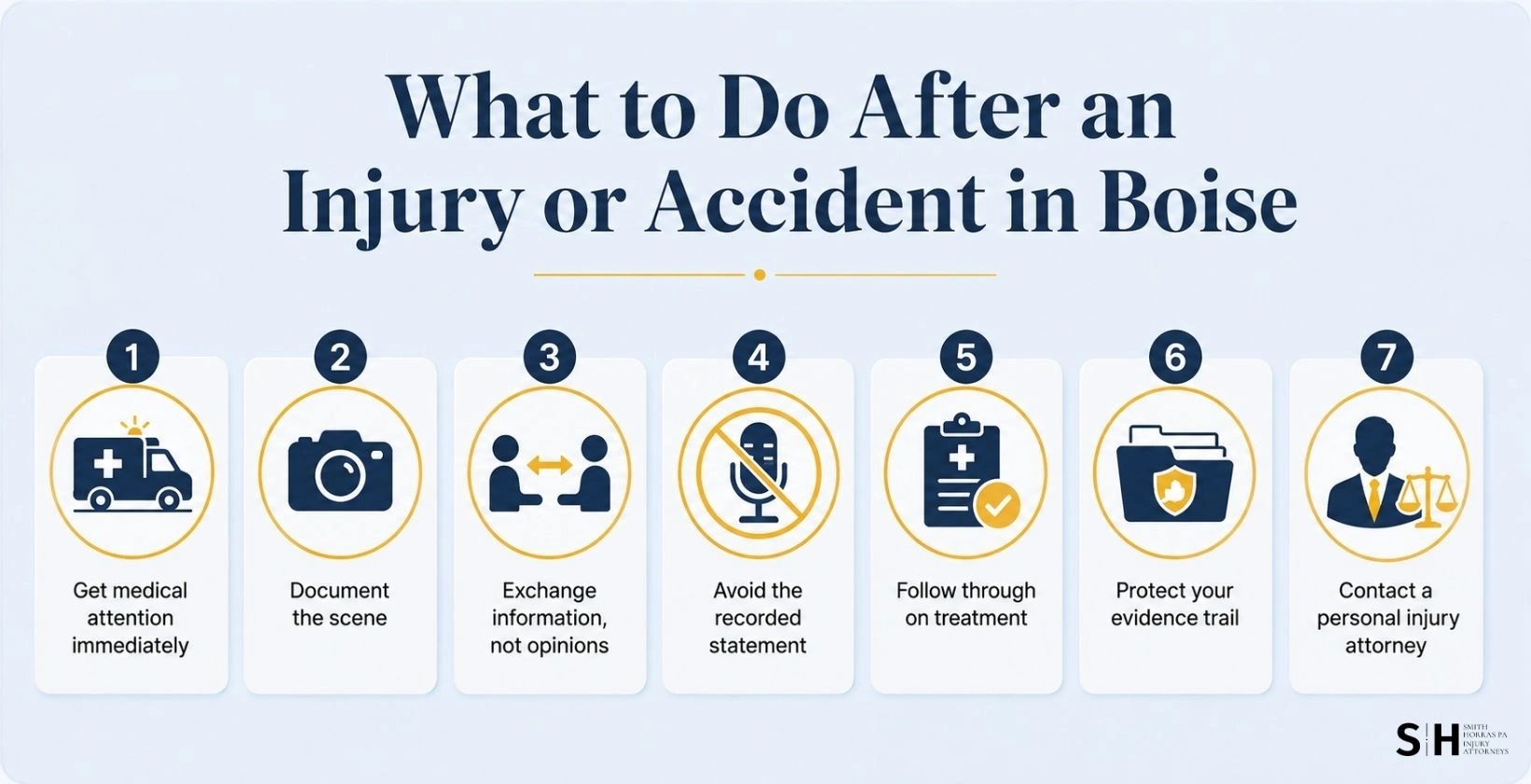
What to Do After an Injury or Accident in Boise
Health comes first, whether it was a crash, a slip and fall, or a dog bite. Everything else, the evidence and the claim, depends on getting that part right before you move on to the rest.
- Get medical attention immediately: Call 911 and get checked out. Some injuries don’t show immediate symptoms until days after the incident, including whiplash, concussions, and soft-tissue damage, so get checked out even if you feel fine. The police or incident report and your medical records become the backbone of the case.
- Document the scene: Photograph the hazard or the vehicles, the road or property conditions, and your visible injuries. If a vehicle was involved, read our guide on 5 most important photos to take after a car accident to know exactly what to capture.
- Exchange information, not opinions: Names, contact information, and insurance details if a vehicle was involved. Know what information to exchange after a car accident, and skip the conversation about who was at fault.
- Avoid the recorded statement: You are not obligated to provide one. Consult a personal injury lawyer before giving one to an insurance adjuster.
- Follow through on treatment: Go to every appointment and finish the recommended care, even once you start feeling better.
- Protect your evidence trail: Old social media posts can be used against your claim months later, so hold onto photographs, bills, and witness information instead of posting about your case.
- Contact a personal injury attorney at Smith Horras, P.A.: The earlier our Idaho injury lawyer is involved, the more evidence we can lock down before it disappears and the fewer mistakes you make while talking to the insurer.
Call (208) 697-5555, or schedule a free consultation if you’d rather write out what happened first. For the full breakdown, read what to do after being injured in an accident.
How Long-Term Injuries Affect Your Injury Claim
Nonfatal injuries can cause lifelong mental, physical, and financial problems, which is exactly the kind of cost a quick settlement tends to miss. CDC’s Cost of Injury data shows that a nonfatal injury serious enough to require inpatient care costs an average of $52,250 in medical expenses and $7,820 in lost work over the following year, and that’s before factoring in care that continues past that first year.
Settling before your condition stabilizes is one of the most common ways people leave money on the table. We wait for maximum medical improvement whenever possible, and bring in treating physicians and life-care planners when needed, to project future treatment, equipment, and any permanent impairment.
Reduced earning capacity gets calculated separately from wages you’ve already lost. A client who can no longer do their pre-injury job has a claim for that difference over their entire working life, not just for the weeks they missed. Getting that number right takes more than a demand letter. It takes a process.
How We Build Your Claim
Every case moves through the same five stages, though how long each one takes depends on the injury and how the insurer responds.
- Starting with a free case review: Free consultation and case evaluation. We review the accident, your injuries, insurance coverage, and available evidence at no cost.
- Locking down evidence early: Investigation and evidence preservation. Accident reports, photographs, medical records, witness statements, and surveillance footage are collected before any of it disappears.
- Putting a number on the damages: Medical documentation and damages calculation. Treatment costs, lost income, and future expenses organized to support the full value of the claim.
- Taking the claim to the insurer: Insurance claim negotiation. A detailed demand package, backed by evidence, negotiated for full compensation rather than the first offer.
- Filing suit if they won’t budge: Litigation and trial preparation. We file suit and prepare for trial when the insurer won’t offer a fair number.
Free consultations are available now, and it’s worth reading about legal help after an injury before you decide whether to call. Either way, you’ll want to know who’s actually handling the file once you do.
The Attorneys Who Will Handle Your Case
Clients work directly with the named attorney on their case, not a rotating case manager. Read more about the firm or why hiring an attorney matters before your consultation. A few questions come up often enough that they’re worth answering here directly.
Frequently Asked Questions About Personal Injury Claims in Boise
How Long Does a Personal Injury Case Take to Resolve?
It depends on injury severity, case complexity, and whether liability is disputed. Minor injuries with clear liability can resolve in a few months. Surgery, permanent injuries, or litigation stretch that out, mostly because settling before reaching maximum medical improvement risks undervaluing future care.
Should I Talk to the Insurance Adjuster Before Hiring a Lawyer?
It’s usually better to talk to a lawyer first. Early statements can shape how the insurer evaluates liability and the value of the claim, even when you think you’re just describing what happened.
Do I Still Need a Police Report if the Other Driver Admits Fault at the Scene?
Yes. A verbal admission at the scene tends to evaporate once the other driver’s insurer gets involved, since drivers often change their account once a claim is filed. The police report is the independent record an adjuster can’t simply argue away.
What Happens if the At-Fault Driver Is Uninsured or Underinsured?
Idaho requires insurers to offer UM/UIM coverage on every auto policy, and a policyholder has to reject it in writing to opt out. If the at-fault driver has no insurance, or not enough, your own UM/UIM coverage, not theirs, may end up being the actual source of your recovery.
What if I Already Gave a Recorded Statement to the Adjuster?
It doesn’t end your claim, but it can be used to challenge your account later. Tell your attorney exactly what you said as soon as possible so any inconsistency gets addressed before it turns into a dispute during negotiation or trial.
Will My Case Go to Trial?
Most personal injury claims settle before trial. We prepare every case as though it’s going to be tried anyway, because insurers offer more to a firm that’s actually ready to file suit and follow through.
How Much Does It Cost to Hire Your Firm?
Nothing up front. We work on contingency, so there’s no fee unless we recover compensation for your claim, and the free initial consultation carries no obligation either way.
Hire an Experienced Boise Personal Injury Lawyer
The decisions you make in the days after a serious accident affect your medical recovery, your available evidence, and your ability to recover compensation, often more than people realize until later.
At Smith Horras, P.A., we help injured clients preserve evidence, document losses, and stay ahead of the legal deadlines that apply to their case. Our Garden City office is at 5561 N. Glenwood St., Suite B, with easy access from Chinden Boulevard, State Highway 44, and Interstate 84. Serious injuries in this area are commonly treated at Saint Alphonsus Regional Medical Center in Boise, a Level II Trauma Center.
We represent injured clients throughout Garden City, Boise, Meridian, Eagle, Nampa, and Caldwell, with consultations available in English. Our client resources page has guides on insurance, medical billing, and what to expect during a claim.
Call us at (208) 697-5555 or request a free consultation online. Cases are handled on contingency, so there’s no attorney fee unless we recover compensation for your claim.