






A sudden slip or fall accident changes everything in a fraction of a second. A fall at a Boise shopping center or a slip on a retailer’s wet floor in Meridian ends the same way: sudden pain, an ambulance ride, and the mounting stress of missed paychecks and incoming medical bills.
You shouldn’t have to carry the financial burden of a property owner’s neglect. Under Idaho premises liability law, businesses and landlords have a duty to keep their walkways safe. When they fail and try to blame you for your own injury, the personal injury team at Smith Horras, P.A. investigates what happened and pushes back. Our slip-and-fall lawyers represent injured Boise and Treasure Valley residents against property owners, retailers, and their insurance companies. We bring over 60 years of combined Idaho trial experience to slip, trip, and fall claims involving broken bones, spinal injury, traumatic brain injury, and wrongful death from falls.
Call us at 208-697-5555 any time, day or night, or request a consultation online to tell us what happened. The consultation is free, and you pay no fee unless we recover for you.
Why Boise Families Turn to Our Slip and Fall Attorneys
- Local and family-owned since 2007: Founded by William “Bill” Smith, based in Garden City since 2009, and still locally owned
- More than 60 years of combined legal experience, with trial and appellate work on the record
- Recognized legal credentials: Founder William “Bill” Smith has been selected to Super Lawyers, Idaho Personal Injury (2023–2026), and The National Trial Lawyers Top 100 (2025)
- No attorney fee unless we recover for you: Case costs are covered upfront, and a fee only comes out of an actual recovery
- Free consultations and 24/7 intake: Serious injuries do not keep business hours, and neither does our intake team
- 5.0-star rating across 53 Google reviews
Call us or visit our Garden City office at 5561 N Glenwood St, Garden City, ID 83714 to discuss your legal options during a free consultation.
What Our Clients Say About Fighting for Fair Treatment
Clear communication, incredible detail, and an advocate the Treasure Valley can count on.
Mr. Horras is an outstanding personal injury attorney in the 208 area. He is professional, knowledgeable, and truly committed to his clients. It’s clear he takes the time to understand each case and advocate for his clients with integrity and care. Communication was clear and thoughtful, and his attention to detail really sets him apart. I would confidently recommend Mr. Horras to anyone in the Treasure Valley who needs strong, trustworthy injury representation.
Personal Injury Client
Testimonials reflect individual experiences. Prior results do not guarantee a similar outcome.
What Counts as a Slip and Fall in Boise, and Who Is Responsible?
A slip-and-fall claim covers far more than slipping on a wet floor. It includes trips on uneven pavement, falls on unmarked stairs, injuries from loose flooring or debris, and falls caused by poor lighting, anywhere a property condition, not your own misstep alone, created the danger.
Idaho law does not require property owners to personally create the hazard to be held liable. A grocery store that ignores a leaking freezer, an apartment complex that neglects a broken railing, or a commercial operator who skips ice removal can all be held responsible. The core legal question is simple: did the owner know, or should a reasonable inspection have revealed, the hazard, and did they fail to fix or warn about it in time? That question of notice, rather than whether you made a minor misstep, is central to whether your claim can proceed.
Invitee, Licensee, or Trespasser: Why Your Status on the Property Changes the Law
Idaho courts sort every visitor into one of three categories, and the property owner’s duty to you shifts with each one.
- Invitees: Customers at stores, restaurants, and shopping centers who enter for the owner’s business purposes. Owners must inspect, repair, and warn. This is the strongest duty Idaho law recognizes.
- Licensees: Social guests who enter with permission for their own purposes. Owners must warn licensees about known hazards that are not open or obvious.
- Trespassers: Owners must avoid willful or wanton conduct toward trespassers, though children receive added protection under Idaho’s attractive nuisance rules.
Invitee status covers the businesses most people visit daily, stores, restaurants, and shopping centers open to the public, which is why it carries the strongest duty of care. That duty is exactly what a claim has to establish next, through the three legal elements that turn an injury into a compensable case.
What You Must Prove to Have a Valid Boise Premises Liability Claim
Idaho law reduces every premises liability claim to three elements, and a claim that is missing even one of them does not survive.
- Duty of care: The property owner owed you a legal duty based on your status as an invitee, licensee, or trespasser.
- Notice and breach: The owner knew or should have discovered the hazard through reasonable inspection and failed to fix or warn about it within a reasonable time.
- Causation and damages: The hazard directly caused your fall, your injuries, and your losses.
An open and obvious hazard does not automatically defeat your claim in Idaho. Idaho courts weigh it as a comparative-fault factor under Idaho Code § 6-801 rather than a bar to recovery, a rule that becomes critical once you understand what actually causes most of these falls.
Common Causes of Slip and Fall Accidents in Boise
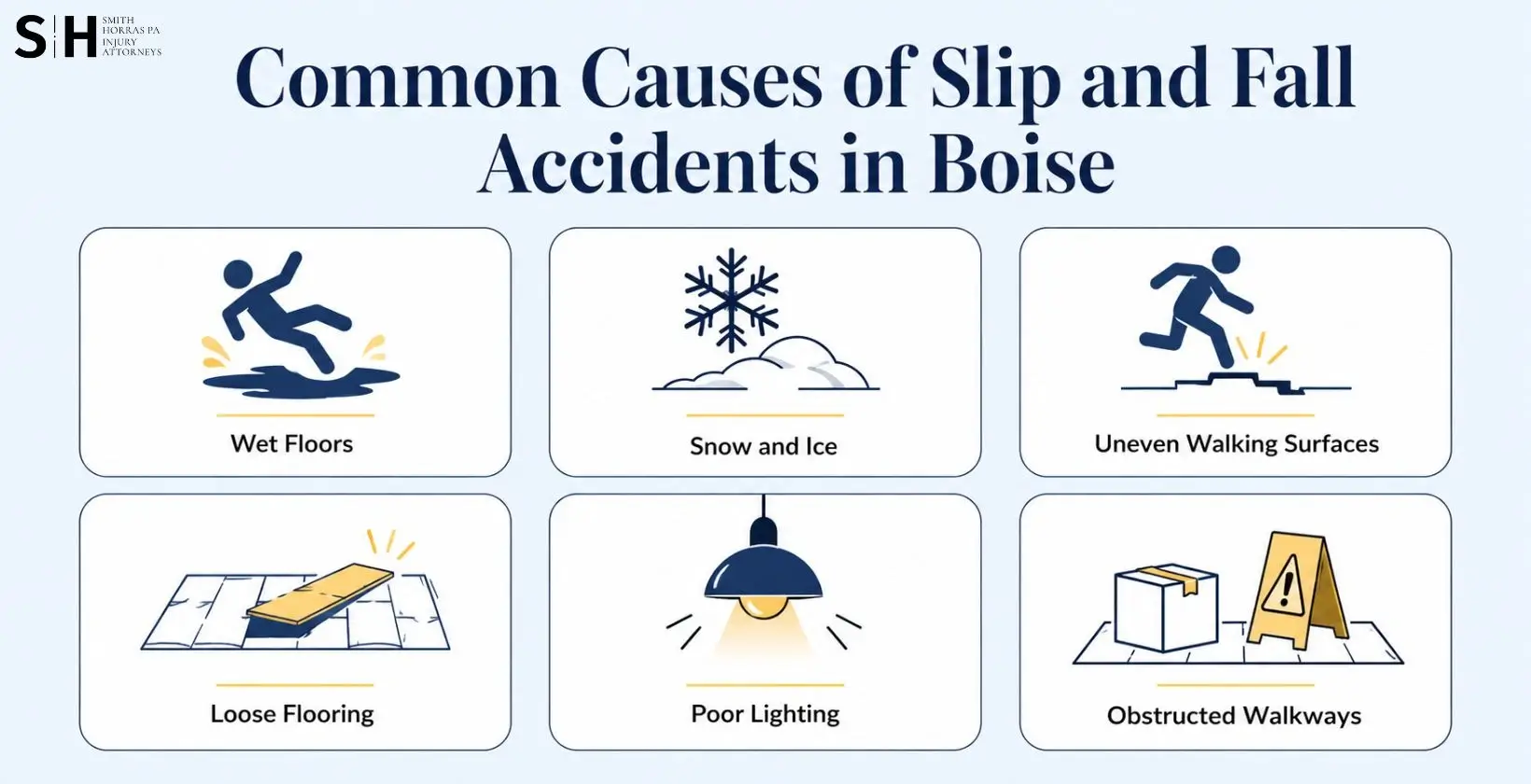
Idaho notice law applies the same way regardless of the hazard, but the specific condition that caused your fall still shapes what evidence we need to prove the owner should have caught it. In the Treasure Valley, premises liability claims typically stem from these causes:
- Wet Floors: Spilled liquids, freshly mopped surfaces, and missing warning signs in stores and restaurants.
- Snow and Ice: Boise’s coldest stretch typically runs from mid-December through February, when overnight freeze-thaw cycles turn cleared walkways back into ice sheets by morning. A single morning treatment often isn’t enough to keep walkways safe through the next freeze.
- Uneven Walking Surfaces: Broken sidewalks, cracked pavement, damaged stairs, and unmarked elevation changes.
- Loose Flooring: Torn carpeting, unsecured mats, and loose tile transitions.
- Poor Lighting: Dim stairwells, parking garages, and walkways that hide hazards until it is too late.
- Obstructed Walkways: Merchandise displays, cords, and debris blocking a clear path.
Grocery stores, big-box retail, restaurants, apartment complexes, hotels, and parking structures are where most slip-and-fall injuries in the Treasure Valley happen. Fast commercial growth along corridors like Chinden Boulevard and State Highway 44 has added foot traffic to properties that were built years before that growth arrived. Wherever the fall happens, the injuries that follow rarely stay contained to the moment of impact.
Common Injuries From a Boise Slip and Fall Accident
Fractures, torn ligaments, and head injuries are common in slip-and-fall accident cases, but some of the most expensive injuries are the ones that do not announce themselves right away. Soft tissue injuries, concussions, and spinal strain can take days to surface fully, and by then a property owner may have already repaired the hazard that caused them.
Documenting the injury early keeps that gap between day-one symptoms and month-six costs from working against the evidence.
What Is Your Boise Slip and Fall Claim Worth?
Your claim’s worth depends on your medical costs, lost income, and the severity of your injuries, both what you’ve already paid and what you’ll need going forward. Idaho splits personal injury compensation into two types of damages.
Economic Damages (Verifiable Financial Losses)
- Emergency room bills, hospital stays, and doctor visits
- Physical therapy, chiropractic care, and future surgical needs
- Lost wages from missed work and reduced future earning capacity
- Out-of-pocket medical devices, prescriptions, and transportation costs
Non-Economic Damages (Quality of Life)
- Physical pain, suffering, and ongoing physical limitations
- Emotional distress, anxiety, and loss of enjoyment of daily activities
What your specific injury claim may be worth depends on how these categories add up in your case. Idaho Code § 6-1603 caps non-economic damages, recalculated annually by the Idaho Industrial Commission. The cap does not apply to cases involving willful or reckless misconduct, or conduct that a jury finds beyond a reasonable doubt would constitute a felony.
What If You Were Partly at Fault for Your Slip or Fall?
You can still recover compensation as long as you are found less than 50 percent at fault. Idaho follows modified comparative negligence under Idaho Code § 6-801, and your percentage of fault reduces your compensation rather than eliminating it.
Fault-sharing scenarios come up often in slip-and-fall cases. A store might argue you were looking at your phone instead of watching your path, walking through a clearly marked “wet floor” area, or wearing shoes unsuited for icy conditions. None of these automatically bar your claim, but each can shift a percentage of fault onto you.
For example, if a jury values your damages at $100,000 and finds you 20 percent at fault for not seeing the hazard, you recover $80,000. Cross the 50 percent line, and Idaho law bars recovery entirely.
Fault arguments like these are exactly what an insurer builds first. Talk to our team before you say anything that could be used to inflate your share of the blame.
Idaho’s Statute of Limitations for Slip and Fall Claims
Idaho enforces two separate deadlines, and missing either one ends your claim regardless of how strong the underlying case is.
- Two-Year Statute of Limitations: Idaho Code § 5-219(4) gives you two years from the date of the fall to file. Courts dismiss claims filed after this window closes, regardless of how strong the case is.
- 180-Day Government Notice: Idaho’s Tort Claims Act (Idaho Code §§ 6-905–6-907) requires a notice of claim within 180 days when a fall happens on government-owned property, including public sidewalks, government buildings, or other public facilities. Missing this shorter window bars the claim even though the two-year clock has not run out.
Deadlines protect your legal right to sue, but they do not stop the property owner’s insurance company from working against you in the meantime.
What to Do in the First 24 Hours After a Fall
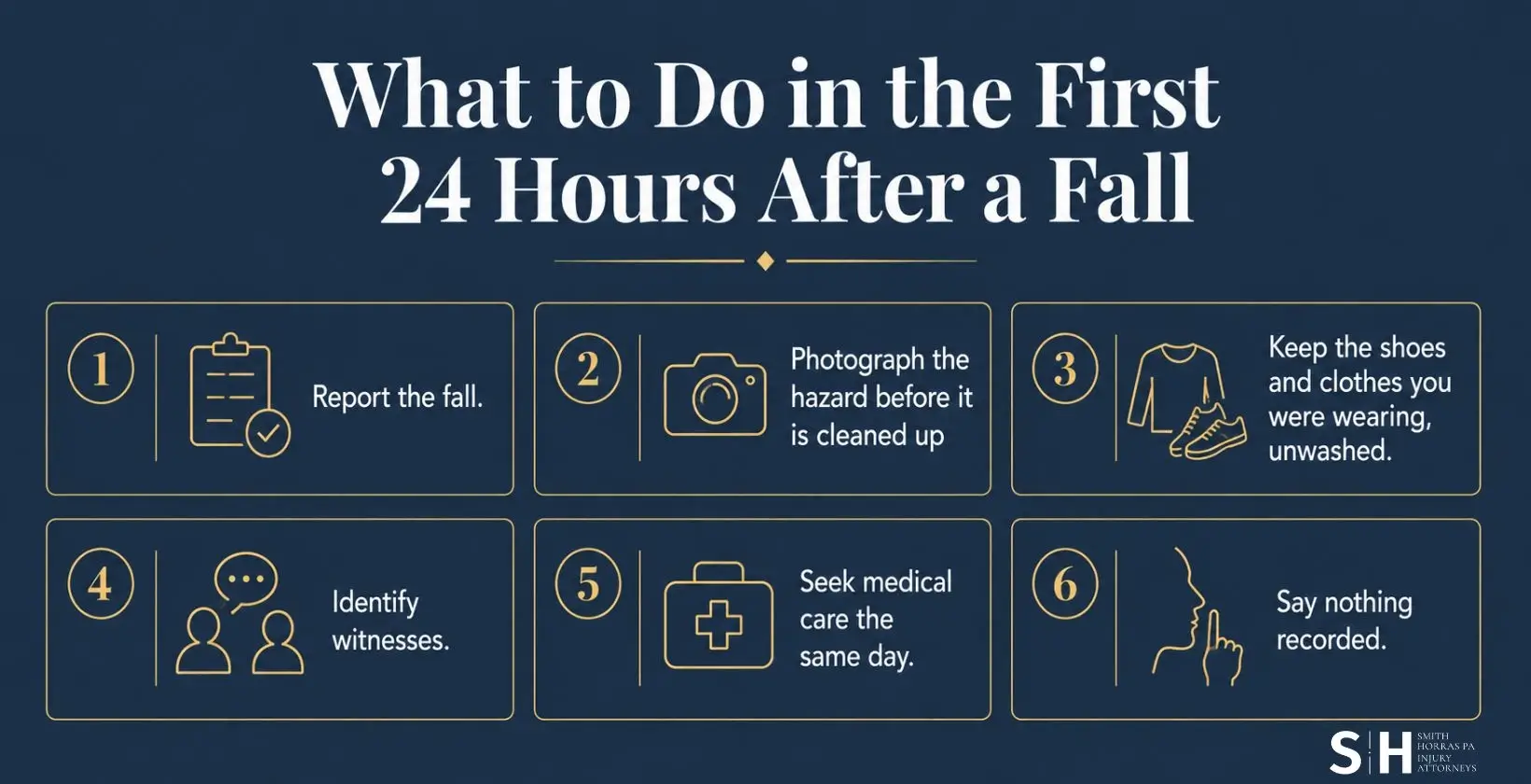
What you do in the hours right after a fall determines how much of your claim survives contact with the property owner’s insurer.
- Report the fall. Notify the property owner, manager, or employee immediately. Ask the manager for a written incident report, and ask for a copy of it before you leave.
- Photograph the hazard before it is cleaned up, along with the lighting, the surrounding area, and anything that blocked your view.
- Keep the shoes and clothes you were wearing, unwashed. If you slipped on something that can be kept, keep that too.
- Identify witnesses. Get names and phone numbers for anyone who saw you fall.
- Seek medical care the same day. Your medical record is what connects the injury to the date, time, and location of the fall.
- Say nothing recorded. Do not give a recorded statement to the property owner’s insurer before speaking with a lawyer.
The property owner’s insurer starts building its side of the claim the moment it learns about the fall, not after you’ve spoken with anyone about it. Surveillance footage disappears first, often on a cycle measured in days. If your fall was recent, call our Garden City office at 208-697-5555 now, while there’s still footage left to save.
How We Build a Slip and Fall Case
Every claim we take on moves through five strategic stages, so that nothing gets missed, and your recovery is protected at every step:
- Confidential Case Evaluation: We review the details of your fall, your injuries, and initial evidence at no cost or obligation to you.
- Investigation and Evidence Preservation: We immediately issue spoliation letters to secure surveillance footage, incident reports, maintenance logs, and witness statements before they disappear.
- Establishing Notice: We gather the proof needed to show how long the hazard existed and that the property owner knew, or should have known, about the danger.
- Medical Documentation & Damages Audit: We organize your medical bills, treatment plans, lost wages, and future care needs to support the full value of your claim.
- Aggressive Negotiation & Litigation: The property owner’s insurer is not on your side. Adjusters reach out early, hoping for a recorded statement or a fast, lowball settlement before you understand the true cost of your injuries. Once we step in, all communication goes through us. Review what not to say to an insurance adjuster before that call comes in. We handle the adjuster, present an evidence-backed demand, and file suit in court if they refuse to offer fair compensation.
Your evidence is strongest in the first days after a fall. The sooner we’re on the case, the more of it we can save.
Meet the Attorneys Handling Boise Slip and Fall Claims
Our firm’s appellate record also includes Prehn v. Hodge, in which the Idaho Supreme Court affirmed in part, reversed in part, and remanded on the attorney fee and cost issues our team raised on appeal (2016).
Frequently Asked Questions
How Long Does a Boise Slip and Fall Case Typically Take to Settle?
Straightforward cases with clear liability and completed medical treatment often resolve in a few months once a demand is sent. Cases involving disputed liability, surgery, or a reluctant insurer can take a year or longer. We give you a realistic timeline once we understand your injuries and the strength of the notice evidence.
What if a Store Asks Me to Sign Something Before I Leave?
Do not sign anything beyond a basic incident report confirming that the fall occurred. Some businesses present a liability waiver or a statement minimizing the hazard while you are still shaken and in pain. You are not required to sign it on the spot, and you should not sign it without a lawyer’s review.
Does Homeowner’s Insurance Cover a Fall at a Friend’s House?
Yes, in most cases. If you fell as a licensee, meaning a social guest, because of a hazard the homeowner knew about and didn’t warn you of, the homeowner’s or renter’s insurance policy typically pays the claim, so you are not usually collecting from the homeowner’s personal assets.
What Happens if the Store’s Surveillance Footage Gets Deleted?
Many systems overwrite footage automatically within days or weeks. If we are retained quickly, we can send a preservation letter demanding that the business retain footage before it is overwritten. Waiting too long can mean losing this evidence permanently.
What if I Was Hurt in a Slip and Fall at Work?
Getting hurt in a workplace slip and fall usually falls under Idaho workers’ compensation instead of a premises liability lawsuit against your employer. A separate claim against a non-employer property owner, such as a client’s building, remains available alongside your workers’ compensation benefits.
Can I Still Have a Case if I Did Not See a Doctor Right Away?
Yes. Some injuries, including soft tissue damage, concussions, and spinal strain, surface days later, so treatment gaps give insurers room to argue the fall didn’t cause your injury. See a doctor as soon as possible to preserve that link.
Talk to a Slip and Fall Accident Lawyer Today
Every day you wait gives insurance companies more time to question your slip and fall injury claim or overwrite critical security video. Let our experienced premises liability legal team handle the insurance adjusters so you can focus on getting better.
If your case does go to litigation, we file in the Fourth Judicial District at the Ada County Courthouse (200 W. Front St., Boise, ID). We proudly represent residents throughout Garden City, Boise, Meridian, Eagle, Nampa, Caldwell, and surrounding communities, across every personal injury practice area we handle.
Call 208-697-5555 day or night, or contact us online to schedule your 100% free, no-obligation consultation. You pay no attorney fees unless we recover compensation for you.
Attorney Advertising. Prior results do not guarantee a similar outcome. Testimonials reflect individual experiences. Every case is unique, and the value of any claim depends on its specific facts. This page is general information and is not legal advice.