






A crash on I-184 can leave you with medical bills, a car you cannot drive, and an insurance adjuster already working to pay you as little as possible. Our founder, Bill Smith, opened Smith Horras in 2007 so Idaho families would not have to face that alone, and our Garden City team has carried that work forward with more than 60 years of combined experience.
Our Idaho car accident attorneys investigate who caused your crash, take over the adjusters, and pursue what your injuries are actually worth. That includes your own uninsured motorist coverage when the at-fault driver cannot pay. Idaho personal injury lawyers at Smith Horras P.A., including Bill and his partner Joe Horras, along with Ellen Smith, also handle catastrophic injury and wrongful death cases resulting from a crash.
You pay no fee unless we win. Call 208-697-5555 anytime, or request your free case review. Our office is at 5561 N. Glenwood Street in Garden City.
Injured Idahoans trust Smith Horras with their car accident claims for concrete reasons:
What Our Clients Say
Our clients describe the same two things in their own words: an attorney who put their recovery ahead of a quick file closure, and an insurer that moved once he got involved.
Testimonials reflect individual experiences. Prior results do not guarantee a similar outcome.
Areas We Serve Car Accident Victims
Smith Horras represents car accident victims across the Treasure Valley and throughout Idaho, and we handle claims in the courts where they are actually decided. Knowing which county your crash falls in, and which court will hear it, shapes how your case is built from the first week.
Beyond Ada and Canyon Counties, we represent injured drivers in Kuna, Star, Mountain Home, Twin Falls, Idaho Falls, Pocatello, Coeur d'Alene, Lewiston, and communities across statewide Idaho. See our full Idaho injury practice areas, or call 208-697-5555 to start your car accident claim now.
What Caused Your Crash, and Who Is Responsible
Every Idaho car accident claim begins by proving that another party's negligence caused your crash. Negligence has four parts: the other party owed you a duty of care, they breached it, that breach caused your injuries, and you suffered real damages as a result. Connecting those four is what turns a collision into a claim an insurer must pay, and insurers know that a claim they can muddy is a claim they can discount.
We investigate the cause rather than accept the adjuster's version of it. Depending on the crash, that means the police report and scene evidence, vehicle damage and reconstruction analysis, and for a commercial-vehicle wreck the records a carrier is not going to volunteer: engine control module and electronic logging device data, GPS histories, driver logs, and the carrier's maintenance and hiring files. Those records can be gone before a claim is even filed, which is why the first call matters.
We handle claims arising from the full range of Idaho crashes:
- Rear-end and intersection collisions
- Distracted, texting, and drowsy driving
- Drunk and impaired driving
- Speeding and reckless driving
- Left-turn and failure-to-yield crashes
- Winter-weather and black-ice collisions
- Commercial truck and semi-truck wrecks
- Hit-and-run and uninsured-driver crashes
Responsibility often reaches past the driver. An employer may be responsible when the driver was working at the time. The vehicle owner's policy may provide coverage even when someone else was driving. A manufacturer may share responsibility when a defective part contributed. A government entity may be liable when a public vehicle played a role, though claims involving highway design run into statutory immunity and require careful analysis. Identifying each one matters, because more responsible parties can mean more insurance available to pay for a serious injury.
One rule shapes every multi-party crash: Idaho compares your fault against each defendant individually, not against all of them combined. That distinction can decide whether you recover at all, and it is the kind of detail an insurer will not volunteer.
Every Day Counts
The Evidence That Wins Your Case Won't Wait
Crash scenes get cleared, vehicles get repaired, and camera footage is overwritten within days. Tell us what happened and we will move to preserve the proof, identify every party who owes you, and build your claim on facts the insurer cannot brush aside.
What You Can Recover in an Idaho Car Accident Claim
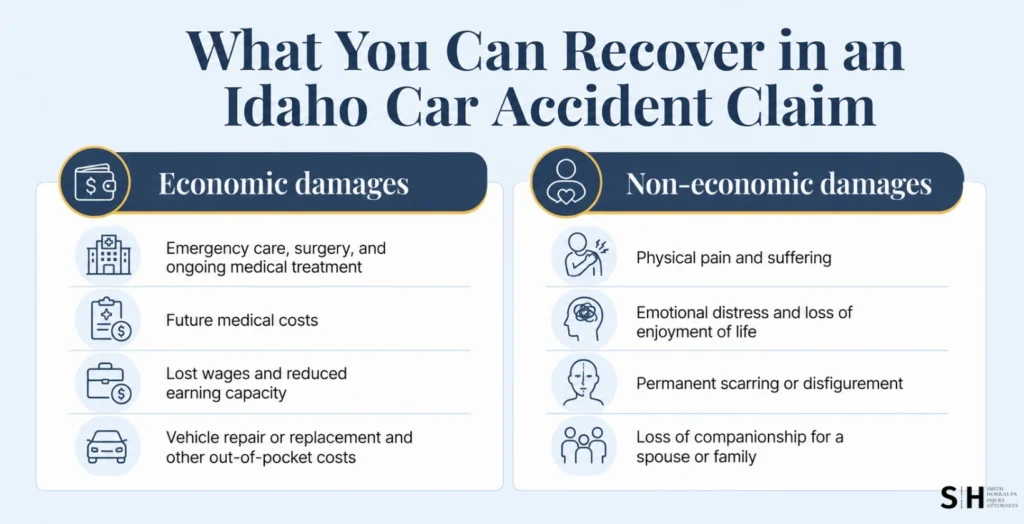
Two categories of damages decide what you collect after an Idaho crash. Economic damages are the costs you can add up; non-economic damages are the real harm that has no receipt. Together they measure what the crash actually took from you.
Economic damages typically include:
- Emergency care, surgery, and ongoing medical treatment
- Future medical costs when your recovery is not finished
- Lost wages and reduced earning capacity
- Vehicle repair or replacement and other out-of-pocket costs
Non-economic damages typically include:
- Physical pain and suffering
- Emotional distress and loss of enjoyment of life
- Permanent scarring or disfigurement
- Loss of companionship for a spouse or family
How Idaho's Two Rules Combine to Set Your Number
Two Idaho rules work together to shape the final figure, and understanding how they interact is where most pages go quiet. Idaho caps non-economic damages under Idaho Code § 6-1603 at an amount the state adjusts each year, and that cap never touches your economic damages. The cap lifts only in two narrow situations: when the at-fault conduct was willful or reckless, or when the trier of fact finds beyond a reasonable doubt that it would constitute a felony. That is a criminal standard sitting inside a civil statute, and it is a higher bar than it first sounds.
Your own share of fault then reduces what you collect. Picture a claim with $150,000 in medical bills and lost wages plus a jury's non-economic award: the economic portion is never capped, the non-economic portion is subject to Idaho's annual limit, and your share of fault reduces what you collect. The categories are valued differently, and an insurer benefits every time one of them is undercounted. Documenting all of it is a large part of what a lawyer adds. For a closer look, see what your injury case is worth and the types of damages you can claim.
The Other Side Already Has Help
You Didn't Choose This Fight. We're Ready for It.
The at-fault driver's insurer has adjusters and lawyers working to pay you as little as possible. Put an Idaho injury team with real trial and appellate experience on your side, and let us carry the fight while you focus on getting better.
Is Idaho a No-Fault State? How Car Accident Insurance Works Here
No. Idaho is an at-fault state, not a no-fault state, and it does not require personal injury protection (PIP). The driver who caused the crash pays through their liability insurance. Idaho Code § 49-1229 requires every driver to carry that insurance, and § 49-117 sets the floor at $25,000 per person and $50,000 per crash for bodily injury, plus $15,000 for property damage. Those minimums are thin, and a serious injury usually costs far more than the at-fault driver carries, which is why the questions below decide so many cases.
What If the Other Driver Was Uninsured or Fled the Scene?
Your uninsured and underinsured motorist coverage is the answer when the at-fault driver has no insurance, too little, or drives off. Idaho requires UM and UIM coverage on every auto policy unless you rejected it in writing or an electronic record, so unless you signed a rejection, you most likely have it. In a hit-and-run, that coverage can pay for your injuries even when the other driver is never found. If a driver fled, call the police immediately, gather every detail you can about the vehicle, and ask any witnesses what they saw. We identify every policy that may apply, starting with your own.
Can You Still Recover If You Were Partly at Fault?
Usually, yes. Idaho follows modified comparative negligence under Idaho Code § 6-801, so you can recover as long as your share of the fault is not as great as the other party's; at 50 percent or more, you recover nothing. Below that line, your damages are reduced by your percentage. If your damages are $100,000 and you are found 20 percent at fault, you recover $80,000. Insurers know this rule and push to pin extra blame on you, and holding your share to what the facts actually support is a core part of our job.
Should You Accept the Insurer's First Offer?
Be cautious with a fast settlement offer. Early offers often arrive before anyone knows how badly you are hurt, and once you sign a release, you cannot reopen the claim if your condition worsens. Some injuries take days to surface, which is why pain can start days after a crash. An adjuster's first number reflects what the company hopes to pay, not what your claim is worth. Before you respond, read what not to say to an insurance adjuster and let us tell you whether the insurance company's offer is enough.
Mr. Horras is an outstanding personal injury attorney in the 208 area. He is professional, knowledgeable, and truly committed to his clients. His attention to detail really sets him apart. I would confidently recommend Mr. Horras to anyone in the Treasure Valley who needs strong, trustworthy injury representation.
Personal Injury Client
Testimonials reflect individual experiences. Prior results do not guarantee a similar outcome.
How Long Do You Have to File a Car Accident Claim in Idaho?
You have two years from the date of an Idaho car crash to file a personal injury lawsuit. That deadline comes from Idaho Code § 5-219(4), and it runs from the day of the crash, not the day you finished treatment or understood how serious your injuries were. Idaho does not offer a general discovery-rule extension for car accident injuries, so waiting rarely helps and usually hurts.
One exception runs on a much shorter clock. When a government entity is responsible, such as a crash involving a public vehicle, Idaho's Tort Claims Act requires a written notice of claim within 180 days, filed with the Secretary of State for a claim against the state or with the clerk or secretary of a city or county. Miss that notice and the claim is barred no matter how much time remains on the two-year clock.
Acting early protects the case itself. Evidence disappears, vehicles get repaired or scrapped, camera footage records over, and witness memories fade.
What to Do After a Car Accident in Idaho
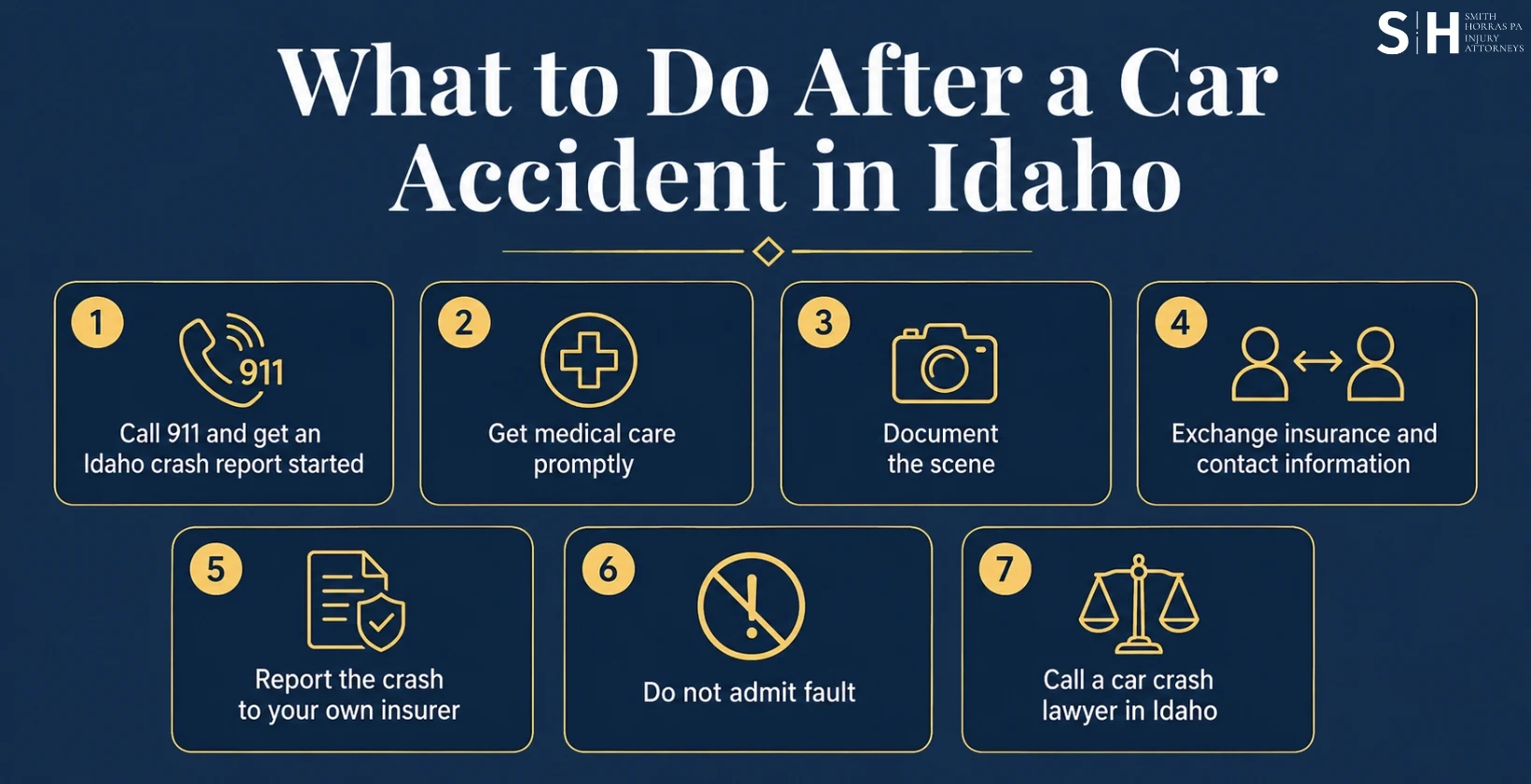
The steps you take after a car crash protect both your health and your claim. Work through them in order:
- Call 911 and get an Idaho crash report started. A police report anchors the official account of what happened.
- Get medical care promptly, even if you feel able to wait, because some injuries surface days later.
- Document the scene. Photograph the vehicles, the road, the damage, and your injuries, and collect witness names and numbers.
- Exchange insurance and contact information, and stick to the facts.
- Report the crash to your own insurer, carefully and without guessing at fault.
- Do not admit fault to anyone at the scene or to any adjuster.
- Call a car crash lawyer in Idaho before you give a recorded statement or accept any offer.
Two records are easy to get wrong: your photos and your own words. Our guides on the most important photos to take and how social media posts can be used against you cover both. Be guarded with the other driver's adjuster, and be completely candid with your own lawyer, because everything you tell us is protected by attorney-client privilege.
Idaho Car Accident Frequently Asked Questions
Most Idaho car accident questions come down to three things: who pays, how long you have, and what a claim is worth.
What Are the Most Common Car Accident Injuries?
Common crash injuries include whiplash and soft-tissue injuries, broken bones, traumatic brain injuries and concussions, and spinal cord and back injuries such as herniated discs. The serious ones drive the value of a claim because they involve future care, lost earning capacity, and permanent limits on daily life.
Can a Car Accident Cause Spinal Stenosis?
Yes, the trauma of a crash can aggravate or accelerate spinal stenosis, even when the condition existed before the collision. A prior diagnosis does not necessarily end your claim, but proving the crash worsened your condition takes full medical documentation of what changed afterward.
Is It Worth Suing After a Hit-and-Run?
Often, yes. Even when the at-fault driver is never found, your own uninsured motorist coverage can pay for your injuries, so a claim is frequently worth pursuing. We review your policy at no charge and tell you what it will support.
How Long Will a Car Accident Case Take?
It depends on the severity of your injuries and whether the insurer disputes fault or value. The single biggest factor is your own treatment: a claim should not resolve until your doctors know what your recovery actually looks like, because settling before then is usually the costlier mistake. We give you a realistic timeline for your specific case at the first consultation.
Do I Have to Go to Court?
Usually not. Most Idaho car accident claims settle. We prepare every case as if it will be tried, which is often what moves an insurer to a fair settlement, and the decision to accept or reject any offer is always yours.
What If the Crash Involved an Uber or Lyft?
Rideshare crashes can add a commercial insurance layer on top of the ordinary rules, and coverage may depend on what the driver was doing at the time. These claims are worth a close look because more coverage may be available than in an ordinary crash.
What Does It Cost to Hire an Idaho Car Accident Lawyer?
Nothing up front. We work on contingency, so you pay no attorney fee unless we recover for you, and the consultation is free. For more, see three things to know about car accident settlement agreements.
Talk to an Idaho Car Accident Lawyer Today
You do not have to face the insurance company alone, and the two-year deadline is already running. Smith Horras will review your Idaho car accident for free, investigate who was at fault, and take on the insurer so you can focus on healing.
No Fee Unless We Win · We Answer 24/7
Let Us Carry This So You Can Heal
The two-year deadline is already running. We will review your Idaho car accident at no cost, take the insurer off your hands, and pursue the full recovery your injuries call for. You pay nothing unless we win.
Attorney Advertising. Prior results do not guarantee a similar outcome. Testimonials reflect individual experiences. Every case is unique and the value of any claim depends on its specific facts. This page is general information and is not legal advice.