




A fatal crash on the Connector, a worksite injury off Chinden Boulevard, or a preventable loss at Saint Alphonsus or St. Luke’s Boise. However it happened, Idaho Code § 5-311 gives certain surviving family members the right to pursue accountability and compensation from the party responsible. Most families do not realize how quickly the legal clock begins to run.
Idaho’s filing deadline is two years from the date of death. When a government entity, city vehicle, or Ada County road defect contributed to the death, a written notice of claim deadline is even shorter. Evidence does not wait for either window.
Smith Horras, P.A. is a Boise personal injury and wrongful death firm based in Garden City. Founding attorney William L. “Bill” Smith and partner Joseph T. Horras lead our wrongful death practice with trial and appellate experience built on Idaho cases. Call our Boise wrongful death lawyer at 208-697-5555 for a free consultation or contact us online. We start investigating the same day we’re retained, and you owe nothing unless we win.
Why Boise Families Choose Smith Horras for Wrongful Death Cases
- Local and family-owned: Founded by William L. “Bill” Smith in 2007, based in Garden City, Idaho, since 2009, and still locally owned.
- 60+ years of combined Idaho legal experience: Spread across three partners who have spent their careers in Idaho courtrooms.
- Recognized legal credentials: William L. “Bill” Smith has been selected to Super Lawyers, Idaho Personal Injury (2023–2026) and The National Trial Lawyers Top 100 (2025).
- Contingency-only billing: Case costs get covered upfront, and a fee only comes out of an actual recovery.
- 24/7 intake: Serious injuries do not keep business hours, and neither does our intake team.
- 5-star service: A 5.0 rating built from 53 Google reviews, and a 4.7 out of 5 across 87 aggregated reviews on Birdeye.
Call us or visit our Garden City office at 5561 N Glenwood St, Garden City, ID 83714 to discuss your legal options during a free consultation.
What Our Clients Say
The reviews come from people who called us during the worst week of their lives.
Wonderful People to Have in Your Corner During a Horrible Time
Bill and his team really care about their cases and invested so much time into mine. They will really go to bat for you. I appreciate them so much. They are willing to go up against big law firms that others would not chance. Wonderful people to have in your corner during a horrible time. I am thankful I didn’t have to navigate it without them.
Personal Injury Client




Prior results do not guarantee a similar outcome. Every case is unique, and the value of any claim depends on its specific facts.
A rating and a review tell you how a firm treats people. Evidence in a wrongful death case starts disappearing within days, and that’s what should worry you right now.
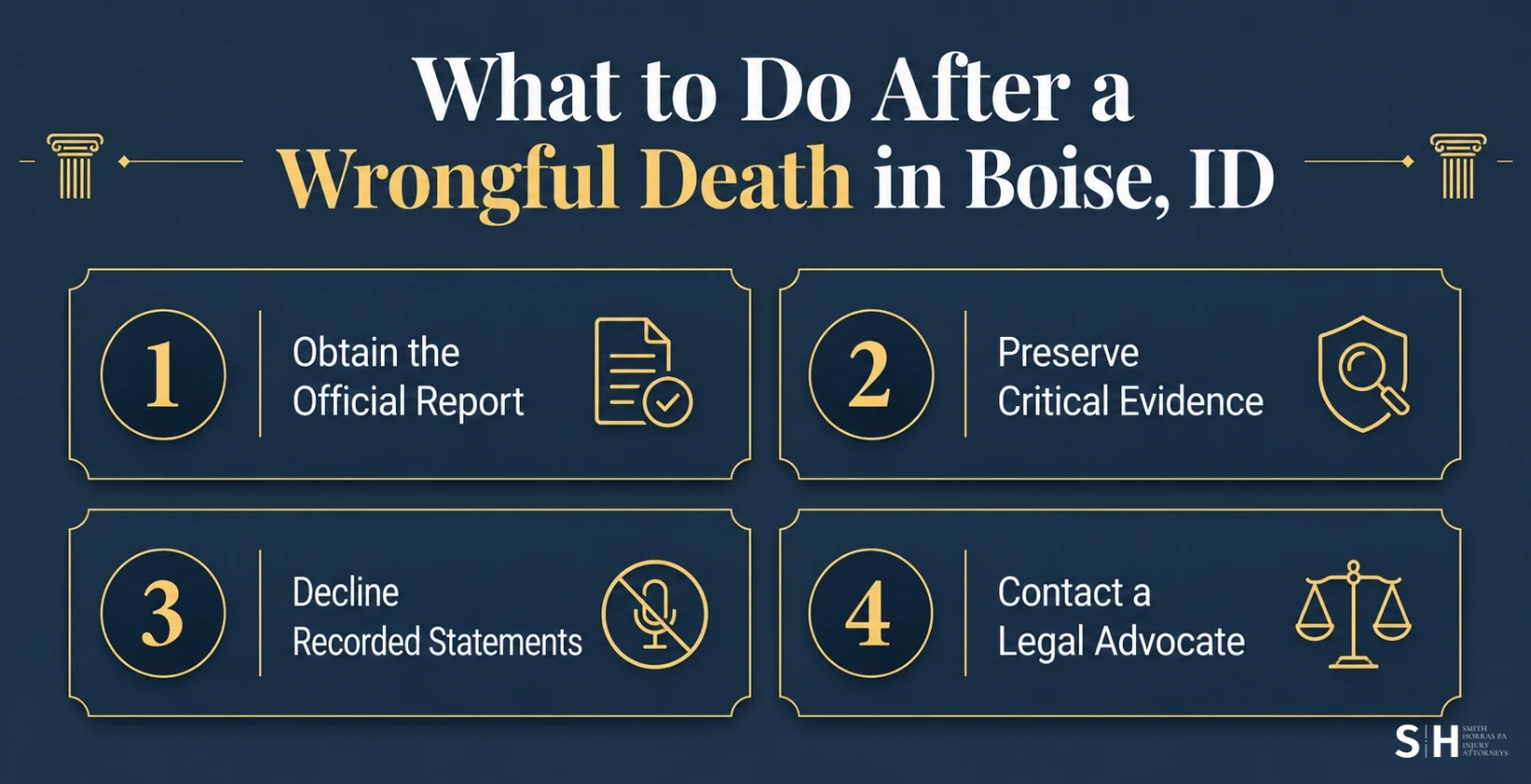
What to Do After a Wrongful Death in Boise, ID
The evidence that supports a legal claim often disappears within days. Taking these vital steps helps safeguard your family’s rights:
- Obtain the Official Report: Request the crash or incident report from the Boise Police Department, Ada County Sheriff, or Idaho Transportation Department as soon as it is available.
- Preserve Critical Evidence: Secure photographs, vehicle electronic data (black box records), and surveillance footage before repairs, site cleanup, or routine video overwrites occur.
- Decline Recorded Statements: Avoid providing recorded statements to insurance adjusters until you have consulted an attorney.
- Contact a Legal Advocate: Early representation protects vital evidence and ensures strict Idaho statutory deadlines are met.
Following these steps preserves your legal options while giving your family space to focus on healing. Under Idaho law, four specific legal elements must be established before a wrongful death claim can proceed.
Every hour matters while evidence remains accessible. Call our nearby Garden City office at 208-697-5555 for a compassionate, free consultation. We begin preserving evidence and handling the insurance companies immediately—and you owe nothing unless we recover compensation for your family.
Do I Have a Wrongful Death Claim in Idaho?
Idaho law tests four elements before a wrongful death claim can move forward, and all four have to hold.
- Duty of care: The at-fault party owed your loved one a legal duty, such as obeying traffic laws, maintaining safe property, or providing safe working conditions.
- Breach: That duty was violated, whether by speeding through an intersection on Chinden Boulevard or ignoring a known workplace hazard.
- Causation: The breach directly caused the death, established through police reports, medical records, and accident reconstruction when needed.
- Damages: The death caused measurable financial and personal losses for the surviving family members.
Miss one element and the claim fails, regardless of how negligent the other party’s conduct looks on paper. Idaho Code § 5-311 defines “heirs” to include a surviving spouse, children, stepchildren, parents, and blood relatives or adoptive siblings who were wholly or partly dependent on the deceased for support. All qualifying heirs have concurrent standing to file. When more than one family member qualifies, we coordinate the claims rather than let competing filings work against each other.
Idaho Wrongful Death Statute of Limitations and Filing Deadlines
Idaho Code § 5-219 gives eligible family members two years to file. That clock starts on the date of death, not the date of the underlying accident. If your loved one survived on life support for two years after a crash, the filing window opens the day they passed away, not the day of the collision.
If a government entity, government vehicle, or unsafe public roadway contributed to the death, the Idaho Tort Claims Act requires a notice of claim within 180 days, before the standard two-year period even applies. Missing either deadline generally ends the claim, regardless of how strong the evidence is.
A wrongful death lawsuit in Ada County is filed at the Ada County Courthouse, 200 W. Front Street, Boise, Idaho 83702. Knowing your deadline matters once you know what caused the death, since that’s what decides who you’re actually filing against.
Causes of Wrongful Death in Boise, Idaho
In 2024, impaired driving claimed 86 lives in Idaho and accounted for more than a third of all traffic crash fatalities in the state, according to Idaho Transportation Department data. What caused a death does more than explain what happened. It determines who can be sued, what has to be proven, and sometimes whether Idaho’s damages cap even applies.
Knowing what caused the death tells you who is liable. It does not yet tell you what happens if your own loved one shared some of the fault, which is the next question worth answering directly.
What If My Loved One Was Partly at Fault?
Idaho follows a modified comparative negligence rule under Idaho Code § 6-801. Your family can still recover as long as your loved one was less than 50% at fault. That percentage reduces any recovery.
Worked example: A jury calculates $400,000 in total damages and finds your loved one 20% at fault. The recoverable amount is $320,000, which is $400,000 minus the 20% reduction. When fault is split across two defendants, each one’s share is calculated individually rather than combined, which is why identifying every liable party early in the investigation changes the final number.
How Much Is a Wrongful Death Claim Worth in Idaho?
No two claims are worth the same amount. The total depends on how the death occurred, how long the deceased would have continued working, what the family has lost in financial support and daily life, and whether Idaho’s cap on non-economic damages applies. Idaho Code § 5-311 allows both economic and non-economic damages.
Economic damages:
- Medical and hospice expenses incurred before death, including care at Saint Alphonsus Regional Medical Center or St. Luke’s Boise Medical Center
- Funeral and burial costs
- Lost income, benefits, and financial support your loved one would have provided
- Loss of household services, such as childcare, home maintenance, and caregiving
Non-economic damages:
- Loss of companionship, society, and consortium
- Loss of parental care, guidance, and nurturing for surviving children
- Loss of the care, comfort, and protection the deceased provided to the family
- Grief and emotional suffering recognized under Idaho law
Idaho Code § 6-1603 caps non-economic damages at a figure the Idaho Industrial Commission adjusts every July 1. Confirm the current figure at the IIC non-economic damages cap page before relying on it, since it changes annually. The cap does not apply where the conduct was reckless, willful, or intentional, which is most relevant in drunk-driving fatalities and cases where evidence shows a deliberate or conscious disregard for safety.
Lost future income is rarely a simple math problem. We typically work with a forensic economist to project what your loved one would have earned, including raises, benefits, and retirement contributions they were on track to receive, rather than relying on a flat multiple of current salary. For more on how we assess overall claim value, see what an injury claim is worth.
How a Wrongful Death Affects a Family Long-Term
A wrongful death affects a family’s finances and daily life well past the funeral. Surviving spouses often absorb lost household income while taking on responsibilities their loved one used to handle. Children lose both financial support and day-to-day guidance during the years that shape the rest of their lives, and parents who lose an adult child often lose the caregiving they expected to receive later on. We document these long-term effects alongside the immediate losses. A claim that only covers the funeral bill isn’t complete, and the insurance company on the other side is counting on your family not knowing that.
Dealing With the Insurance Company After a Wrongful Death in Boise
Idaho’s minimum liability limits are $25,000 per person, $50,000 per accident, and $15,000 for property damage, limits that fall far short of covering a wrongful death claim’s losses. Idaho law requires insurers to include uninsured/underinsured motorist (UM/UIM) coverage in every auto policy by default, and a policyholder who wants to decline it must do so in writing, which is why we review both the at-fault driver’s policy and your own family’s coverage early.
Insurance companies open their own investigation within days of a fatal accident, often before a family has had time to grieve. Taking that fight off your hands is only half the job. Building the claim itself is the other half.
If the insurance company has already been in contact, call 208-697-5555 or contact us today. We can take over communications the same day.
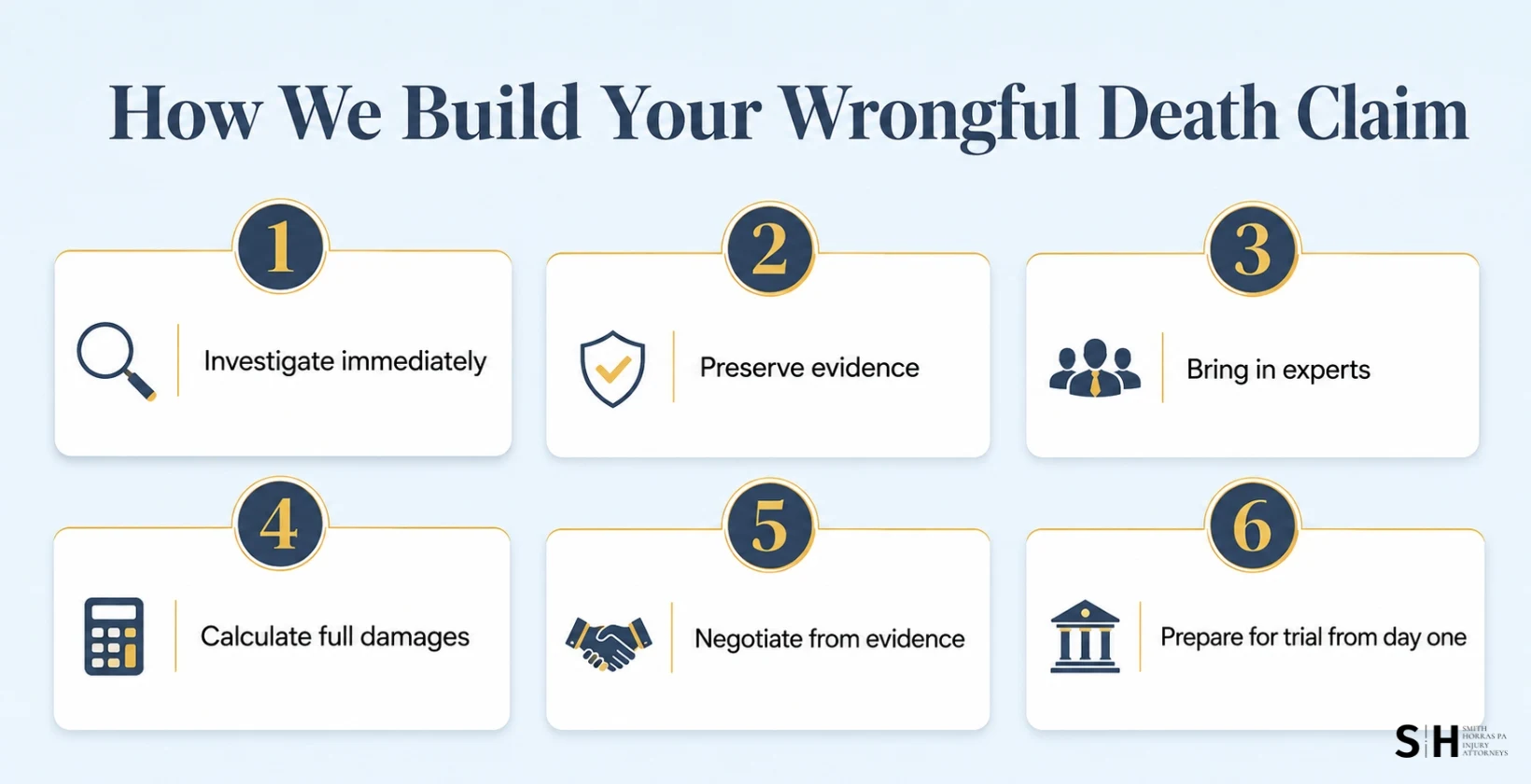
How We Build Your Wrongful Death Claim
That building process starts immediately and follows the same sequence on every wrongful death matter we take.
- Investigate immediately: Police reports, medical records, employment records, and witness statements establish how the death occurred.
- Preserve evidence: Photographs, vehicle data, and surveillance footage before repairs, cleanup, or routine deletion occur. Be careful what you post publicly, since social media activity can be used against a claim even when it seems unrelated.
- Bring in experts: Accident reconstruction specialists, forensic economists, and medical experts when liability, causation, or future loss is disputed.
- Calculate full damages: Economic losses, lost financial support, and personal impact documented before any demand is sent.
- Negotiate from evidence: A documented demand, not the number an insurer expects you to settle for. We know when an insurance offer falls short, and we don’t accept less.
- Prepare for trial from day one: Every case is built with the documentation litigation requires, whether or not it goes to court.
Every step in this process is handled by the attorney assigned to your case. Joseph T. Horras focuses his practice on wrongful death cases. William L. “Bill” Smith and Ellen N. Smith step in for the estate and family-law questions that often come with them.
The Attorneys Who Will Handle Your Wrongful Death Case
The Smith Horras team has handled wrongful death and catastrophic injury cases in Idaho since 2007, with trial and appellate work on the record. William L. “Bill” Smith and Joseph T. Horras prepare every case as though it will be tried, which is frequently what moves an insurer to a fair number. Ellen N. Smith covers the estate and family-law matters that often accompany a wrongful death claim.
William L. “Bill” Smith founded Smith Horras after clerking for Judge J. William Hart and practicing in Twin Falls and Boise. He has been licensed under Idaho State Bar No. 6134 since 2000, is admitted to the U.S. Court of Federal Claims, and was selected to Super Lawyers, Idaho Personal Injury, every year from 2023 through 2025, and to The National Trial Lawyers Top 100 in 2025.
Joseph T. Horras focuses on wrongful death, catastrophic injury, and insurance bad-faith claims. Licensed since 2004, he argued and won U.S. v. Swisher before the full Ninth Circuit sitting en banc in 2016, an appellate record that carries weight with an insurer deciding how hard to contest a claim.
Ellen N. Smith also clerked for Judge J. William Hart before serving as a Jerome County deputy prosecutor and joining Smith Horras as a partner in 2008. She has been a certified family-law mediator since 2019.
Frequently Asked Questions
What Is the Difference Between a Wrongful Death Claim and a Survival Action?
A wrongful death claim compensates surviving family members for their own losses. A survival action, filed on behalf of the estate, recovers the pain, suffering, and expenses your loved one experienced between injury and death. Idaho allows both claims to proceed together.
Who Is the Personal Representative in an Idaho Wrongful Death Case?
The personal representative is the person authorized to act for the deceased’s estate, named in a will or appointed by the probate court. In a wrongful death case, they coordinate with the family members bringing the claim, especially when a survival action is filed alongside it.
Can Siblings or Grandparents File If There’s No Spouse, Child, or Parent?
Yes. Idaho Code § 5-311 extends filing rights to dependent blood relatives and adoptive siblings when no spouse, child, or parent survives to bring the claim. Some cases also involve stepchildren or a former spouse whose marital status is disputed. A free consultation can confirm your family’s exact standing.
Does Idaho Recognize Wrongful Death Claims for Unmarried Partners?
No. Idaho’s wrongful death statute prioritizes a surviving spouse, children, and parents, so unmarried partners typically lack independent standing to file on their own. A partner may still have options through the estate or another qualifying family member’s claim, which is worth discussing directly.
Can We File a Wrongful Death Claim If the Accident Happened Out of State?
It depends on where the death occurred and where the at-fault party can be sued. Idaho courts typically have jurisdiction if the fatal incident happened in Idaho, regardless of where the at-fault party lives. A death that happened elsewhere may fall under a different state law, which we determine at the start of a case.
How Is a Wrongful Death Settlement Distributed Among Family Members?
Distribution depends on Idaho’s wrongful death statute and, in some cases, court approval, particularly when minor children are among the beneficiaries. Funds are generally allocated among the qualifying family members named in the claim, not paid as a lump sum to a single person to divide informally.
Does a Pending Criminal Case Affect My Family’s Civil Claim?
No. A wrongful death claim is a separate civil action and proceeds independently of any criminal charges against the at-fault party. A conviction can support your case as evidence, but an acquittal or dropped charges do not end your family’s right to pursue compensation.
How Long Does a Boise Wrongful Death Case Take to Resolve?
It depends on liability disputes, the number of parties involved, and whether the case settles or proceeds to trial. Cases with clear liability often resolve in months; contested cases requiring litigation commonly take a year or more. We give families a realistic estimate once the investigation is underway.
Does It Cost Anything to Hire a Boise Wrongful Death Lawyer?
No. Smith Horras handles wrongful death cases on contingency, so your family pays nothing up front. We cover case costs during the investigation, and our fee comes only out of an actual recovery. If we don’t win your case, you owe us nothing.
Contact a Boise Wrongful Death Lawyer Today
Every week that passes is a week when evidence can disappear, and the two-year clock keeps running.
Call our Garden City, Idaho office at 208-697-5555 or request a free consultation online. We serve Boise, Meridian, Eagle, Nampa, Caldwell, and communities throughout Ada and Canyon Counties. The consultation is free, and you pay nothing unless we recover compensation for your family.
Attorney Advertising. This website is designed for general information only. The information presented should not be construed as formal legal advice, nor the formation of a lawyer/client relationship.