





If a commercial truck hit you or someone you love, you are dealing with injuries a car crash rarely produces, and with a company whose insurer very likely started working the claim before you left the hospital. Our founder, Bill Smith, opened Smith Horras, P.A. in 2007 so Idaho families would not have to face that alone, and our Garden City team has carried that work forward with more than 60 years of combined experience.
Our Idaho truck accident attorneys move first on the evidence a carrier controls: the driver’s hours, the electronic logs, the maintenance and hiring files, and the data inside the truck itself. Some of those records are only required to exist for six months. We work to identify each company that shares responsibility, take the adjusters off your hands, and build the case for the full extent of what you have lost.
You pay no fee unless we win. Call 208-697-5555 anytime, or request your free case review. Our office is at 5561 N. Glenwood Street in Garden City.
What we bring to a truck accident claim:
- An Idaho family-owned injury firm serving the Treasure Valley and statewide since 2007
- More than 60 years of combined legal experience, with trial and appellate work on the record
- Founder Bill Smith named to The National Trial Lawyers Top 100 (2025) and selected to Super Lawyers for Idaho personal injury, 2023 through 2026
- Joe Horras was prevailing counsel before the full Ninth Circuit Court of Appeals sitting en banc
- Rated 5.0 across 53 Google reviews
- Free consultations, and no attorney fee unless we recover for you
What Our Clients Say
Our clients tend to describe the same thing: an attorney who took the pressure off them and paid attention to the details that decided the case.
After a serious car accident in 2023, I was facing a long recovery and a lot of uncertainty. Hiring Joe Horras turned out to be one of the best decisions I made during that entire process.
From day one, Joe made it clear that my health and recovery came first. He never rushed the process and was extremely patient as I worked through treatments and ultimately surgery. Knowing that he was focused on doing what was best for me, not just closing a case quickly, gave me a tremendous amount of confidence and peace of mind.
I worked with Joe for well over a year, and throughout that entire time his communication and professionalism were outstanding. He and his staff were always responsive, transparent, and willing to take the time to explain things clearly. Katie, Armondo, and the rest of the team were fantastic, always attentive, supportive, and quick to help whenever I had questions or needed guidance. It truly felt like I had an entire team advocating for me.
When it finally came time to resolve the case, Joe absolutely exceeded my expectations. His experience, preparation, and dedication showed in the final result, and I’m incredibly grateful for the outcome he helped achieve.
If you are looking for an attorney who truly advocates for his clients, communicates consistently, and prioritizes people over process, I highly recommend Joe Horras and his entire team. They went above and beyond for me, and I will always be thankful for the way they handled my case.
– Zach Butler, Google Review
Wow! Want ethical, hard-working people who take the time to fully explore your case, communicate thoroughly, and truly represent your interests? This legal team is for you.
Our son was hit by a teen driver several years ago and the driver’s insurance company was foot dragging about settling. We are talking YEARS here.
We turned to Joe Horras for help and within a few WEEKS he had the case resolved. Truly an amazing man. Every communication from Joe was timely, respectful, informative and helpful. He was great about keeping us informed of his progress and next steps.
Everyone we met at Smith Horras was professional, compassionate, incredibly intelligent and very knowledgeable. I hope I don’t need an attorney again soon, but if I do, this is our team.
– Trudi Sabaj, Google Review
Testimonials reflect individual experiences. Prior results do not guarantee a similar outcome.
Where We Handle Idaho Truck Accident Claims
Idaho is a freight state. I-84 carries interstate trucking across the entire southern half of it, I-86 and I-15 feed the eastern corridor, and I-184, Chinden Boulevard and State Highway 44 push that traffic straight through the Treasure Valley where most people actually live. We represent people hurt by commercial vehicles along all of it, and we handle claims in the courts where they are actually decided.
Knowing which county your crash falls in matters from the first week, because it shapes which court system your case sits in and who we deal with locally.
How Our Idaho Truck Accident Lawyer Builds Your Case
To prove a truck accident claim, you have to show that the other party owed you a duty of care, breached it, that the breach caused your injuries, and that you suffered real losses. What changes in a trucking case is where the proof comes from. We go after the carrier's own records, and we do it early:
The driver's logs are the single most important record in most trucking cases, and the engine data can be the most precise, yet neither is guaranteed to survive. That is why one of the first things we do is send a preservation letter, putting the carrier and its insurer on notice not to destroy the evidence. It only helps if it goes out while the records still exist. We also secure the crash report and scene evidence, run reconstruction analysis, download the black box where we can, gather the medical and wage records that show what the crash cost you, and bring in a trucking-safety expert where a case needs one.
If a commercial truck hurt you or someone in your family, tell us what happened and we can get a preservation letter out while the records still exist. Get a free case review. If you are still deciding, read our guide on why legal help matters after a serious injury.
Who Is Responsible for an Idaho Truck Crash
In a car accident, there is usually one driver to hold accountable. In a truck accident, there are often several companies, and identifying all of them matters, because more responsible parties can mean more insurance available to pay for a serious injury.
Not sure which companies are on the hook for your crash? Tell us what happened and we will look into it at no cost to you. Talk to an Idaho truck accident lawyer.
What Causes Idaho Truck Accidents
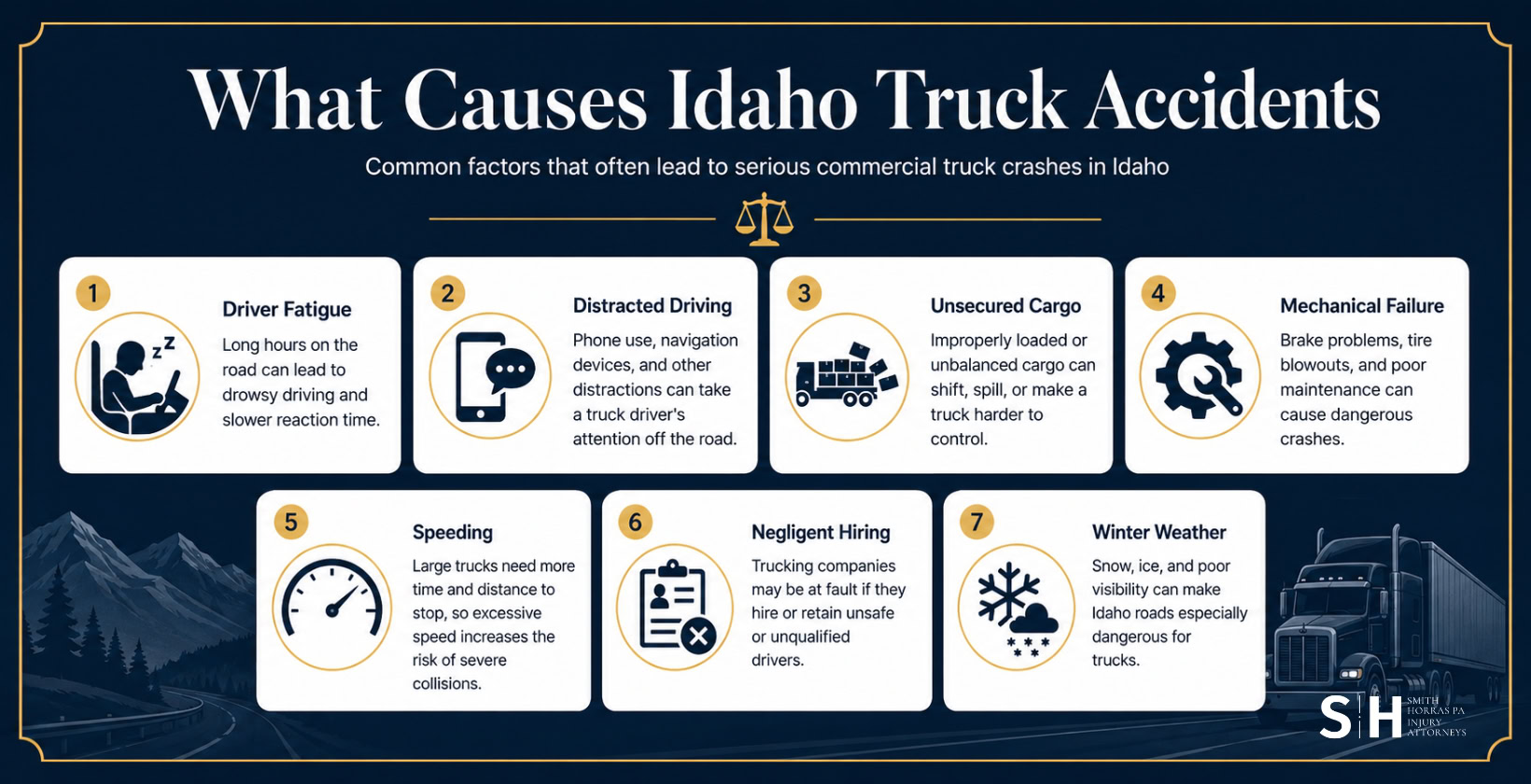
Most commercial truck crashes trace back to a decision someone made before the truck ever reached the road. The causes we see most often in Idaho:
- Driver fatigue and hours-of-service pressure. Federal rules generally allow 11 hours of driving after 10 consecutive hours off duty, inside a 14-hour window, with a 30-minute break required after 8 hours of driving time, and weekly ceilings of 60 hours in 7 days or 70 hours in 8. Dispatch schedules that cannot be met legally are a recurring cause.
- Distracted and impaired driving. Federal rules bar a commercial driver from operating with an alcohol concentration of 0.04 or greater, which is a stricter standard than the one applied to ordinary drivers.
- Improperly loaded or unsecured cargo. Securement systems must be able to withstand roughly 0.8 g of force forward and 0.5 g rearward and to each side, and cargo must be secured so it cannot leak, spill, blow or fall from the vehicle, or shift enough to affect stability.
- Brake, tire and steering failure, and skipped maintenance on a truck that should have been out of service.
- Speed and following distance that would be fine in a car and are not survivable in a loaded truck, particularly on grades and in winter conditions.
- Negligent hiring, inadequate training and pressure from the carrier to keep moving.
- Winter weather, black ice and blowing snow on the interstate corridors.
The injuries that follow are different in kind, not just degree. Traumatic brain injury, spinal cord injury, crush and orthopedic injuries requiring multiple surgeries, serious burns and amputation are all common outcomes in commercial vehicle crashes, and so is a long recovery with an uncertain endpoint.
The financial damage starts immediately, which is the part families are least prepared for. Medical bills begin arriving while the wages stop. Those losses are real, and they are recoverable, but only if someone documents them from the beginning.
What You Can Recover After an Idaho Truck Accident
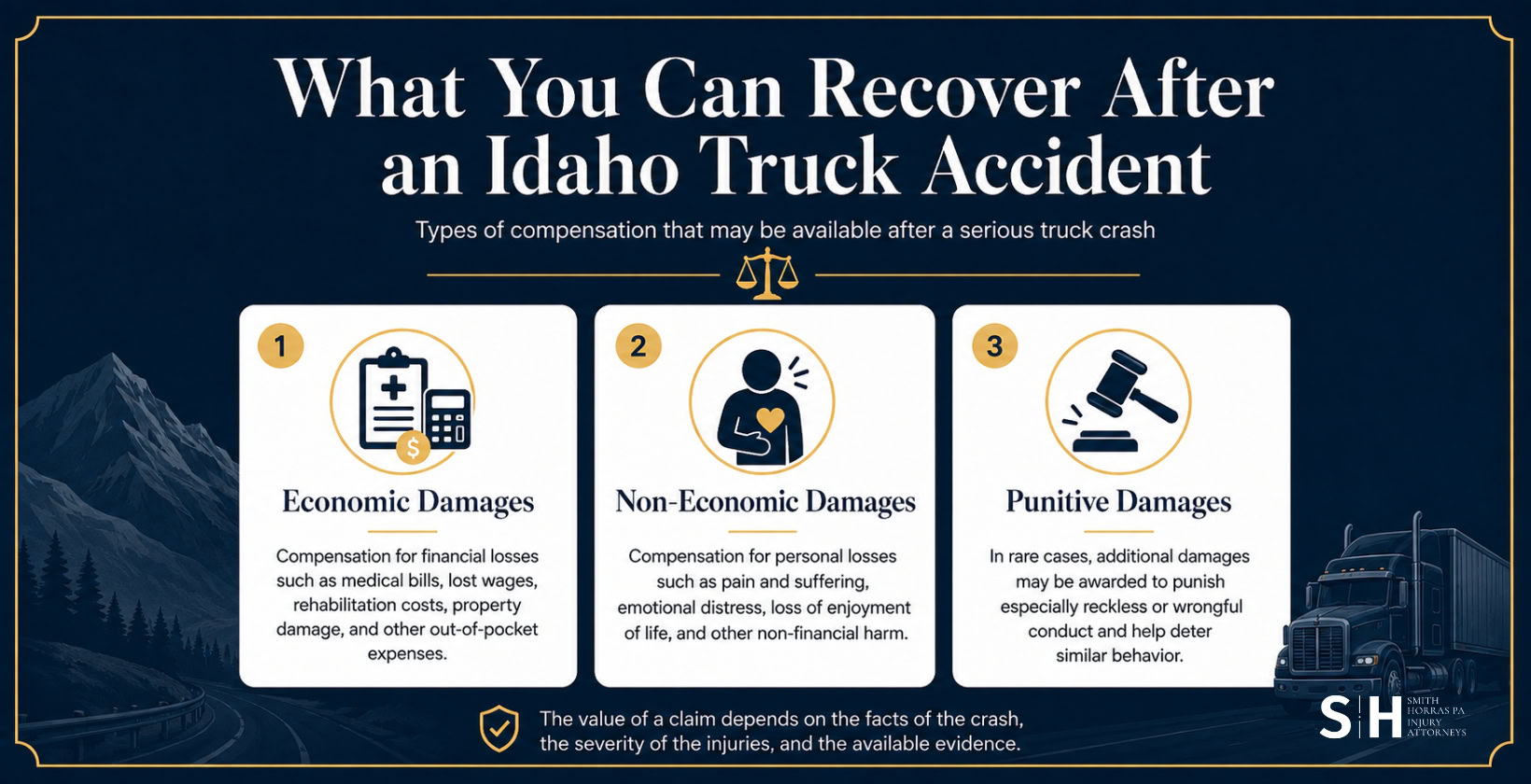
Two categories of damages decide what you collect. Economic damages are the losses you can add up. Non-economic damages are the harm that has no receipt.
Economic damages typically include:
- Emergency care, surgery, hospitalization, and ongoing medical treatment
- Future medical costs and long-term care when your recovery is not finished
- Lost wages and reduced earning capacity when you cannot return to the work you did
- Vehicle repair or replacement and other out-of-pocket costs
For a closer look at how these are valued, see what an injury claim is worth and the types of damages you can claim.
Non-economic damages typically include:
- Physical pain and suffering
- Emotional distress and loss of enjoyment of life
- Permanent scarring, disfigurement or disability
- Loss of consortium and lost household services for a spouse and family
There is usually more insurance in truck accident cases than in an ordinary crash. Under 49 CFR § 387.9, a for-hire interstate carrier hauling general freight in a vehicle rated at 10,001 pounds or more must carry at least $750,000, and hazmat carriers $1 million or $5 million, against an ordinary Idaho driver's minimum of $25,000 per person under Idaho Code § 49-117. That federal figure is a floor, not what a fleet actually carries, and finding the excess layers is part of our work. Your own uninsured and underinsured motorist coverage can also matter, and health insurers may assert reimbursement interests against your recovery, so a claim should not settle before your doctors know what your recovery looks like. For more, see what an injury claim is worth.
Idaho's Cap on Non-Economic Damages
Idaho limits non-economic damages under Idaho Code § 6-1603, at an amount the state recalculates every July 1.
What matters more than the number is what the cap does not reach. It never touches your economic damages, so medical bills, future care, and lost earning capacity are not capped at all. And it lifts entirely in two situations: when the conduct was willful or reckless, or when the trier of fact finds beyond a reasonable doubt that the act would constitute a felony. That second one puts a criminal standard of proof inside a civil statute, and in a case involving an impaired or grossly reckless driver it is worth examining rather than assuming away.
When Punitive Damages Are Available
Punitive damages are rare, and in Idaho you cannot ask for them at the start of a case. Idaho Code § 6-1604 sets a high bar: clear and convincing evidence of oppressive, fraudulent, malicious, or outrageous conduct, and bars putting a punitive claim in the original complaint at all. So nobody can promise them early. If awarded, they are capped at the greater of $250,000 or three times the compensatory damages, and the non-economic cap does not apply to them.
If an insurer has already made you an offer, we can review it with you before you respond. Request your free case review.
The Idaho Laws That Decide a Truck Accident Claim
How Long You Have to File
You have two years from the date of the crash under Idaho Code § 5-219(4), running from the day of the crash rather than the day you finished treatment.
However, there are two exceptions to this rule:
- When a government entity is responsible, the Tort Claims Act requires written notice within 180 days, to the Secretary of State for a claim against the State or to the clerk or secretary of a city, county or district otherwise, and missing it bars the claim.
- If the injured person is a minor, Idaho Code § 5-230 can pause the deadline until they reach adulthood, up to a maximum of six years.
Two years is real time, and you should use some of it. But settling before you reach maximum medical improvement is the more common and more expensive mistake. Talk to us before you decide to sign anything.
What If You Were Partly at Fault
Usually you can still recover. Idaho follows modified comparative negligence under Idaho Code § 6-801, so you can recover as long as your share of the fault is not as great as the other party's. At 50%, you recover nothing. Below that line, your damages are reduced by your percentage, so $200,000 in damages with 20 percent of the fault becomes $160,000.
There is a wrinkle specific to trucking cases. Idaho compares your fault against each defendant individually, not against all of them combined. With a driver, a carrier, and a cargo loader in the same case, the comparison runs separately against each one. That can decide whether you recover from a particular defendant at all, and it is the kind of rule an adjuster will not volunteer while they are working to move fault onto you.
The Federal Rules That Apply to Idaho Trucks
Interstate carriers are governed by the Federal Motor Carrier Safety Regulations, the source of the hours-of-service, logging, driver-qualification, and cargo-securement rules. Idaho also adopts most of them for intrastate carriers through IDAPA 11.13.01, stripping out the exemptions that would otherwise apply, with a reduced set for the smallest trucks between 10,001 and 26,000 pounds that does not include hours of service. A tractor-trailer is far above that weight, so the full set applies to it either way.
What to Do After an Idaho Truck Accident
The steps you take in the first days protect both your health and your claim. Work through them in order:
- Call 911 and get an Idaho crash report started. A police report anchors the official account of what happened.
- Get medical care promptly, even if you feel able to wait. Some serious injuries do not present at the scene.
- Photograph everything you safely can, including the tractor and the trailer separately, the damage to both vehicles, the road, and your injuries.
- Photograph the DOT number and the company name on the truck door. In a crash involving a leased tractor or a separate trailer owner, that number is often the fastest way to identify who is actually responsible.
- Get names and phone numbers for any witnesses before they leave the scene.
- Report the crash to your own insurer, carefully, and without guessing at fault.
- Decline to give a recorded statement to the trucking company's adjuster until you have talked to a lawyer.
- Call an Idaho personal injury lawyer while the carrier's records still exist.
Be guarded with the other side's adjuster and completely candid with your own lawyer. We treat what you tell us as confidential. Our guide on what not to say to an insurance adjuster covers the conversations that tend to cause the most damage.
Idaho Truck Accident Questions We Hear Most
What Does It Cost to Hire an Idaho Truck Accident Lawyer?
It costs nothing up front to hire our truck accident attorneys. We work on contingency, so you pay no attorney fee unless we recover for you, and the consultation is free.
What If the Truck Driver Was Not Cited at the Scene?
A citation helps, but it is not required. Fault in a civil claim is proved by evidence, not by whether an officer wrote a ticket. It is worth knowing that federal post-accident drug and alcohol testing is automatic after a fatality, but in an injury or tow-away crash it is only required if the driver receives a citation. When a driver is not cited and never tested, the absence of that test is itself a fact worth developing.
Should I Take The Trucking Company's First Settlement Offer?
Be cautious. An early offer usually arrives before anyone knows how badly you are hurt, and once you sign a release, you cannot reopen the claim if your condition worsens. Before you respond, read whether the insurance company's offer is enough, or let us look at it with you.
How Is Fault Proven When the Driver Says They Were Not Speeding?
We prove fault through records rather than argument. Engine data, electronic logs, the physical evidence at the scene, and a reconstruction analysis usually give a far more reliable account than either driver's memory.
What If the Truck Was Owned by One Company and Driven for Another?
That is common in trucking, and it usually helps rather than hurts. Separate ownership, leasing, and operating arrangements often mean separate insurance policies, and each one is a potential source of recovery. Sorting out those relationships is part of the early investigation.
How Long Will an Idaho Truck Accident Case Take?
It depends on the severity of your injuries and whether the carrier disputes fault. The biggest factor is your own treatment, because a claim should not resolve until your doctors know what your recovery looks like. We will give you a realistic timeline for your specific case at the first consultation.
Do I Have to Go to Court?
Usually not. Most claims settle. We prepare every case as though it will be tried, which is often what moves a carrier's insurer to a fair number, and the decision to accept or reject any offer is always yours.
Talk to an Idaho Truck Accident Lawyer Today
You do not have to take on a trucking company and its insurer by yourself, and the records that prove your case are already on the clock. We will review your Idaho truck accident for free, work to put the carrier on notice before its records age out, identify the companies that share responsibility, and take the insurers off your hands so you can concentrate on recovering.
Call 208-697-5555 or request your free consultation. We answer 24/7, and there is no fee unless we win your case.
Attorney Advertising. Prior results do not guarantee a similar outcome. Testimonials reflect individual experiences. Every case is unique, and the value of any claim depends on its specific facts. This page is general information and is not legal advice.