





A fully loaded semi-truck or tractor-trailer on I-84 or Chinden Boulevard weighs up to 80,000 pounds, twenty times more than a passenger car. When an 18-wheeler or a big rig jackknifes on an on-ramp or T-bones a vehicle along Glenwood Street, it causes catastrophic injuries, and the carrier’s insurance company often starts building a defense before you even leave the hospital.
Commercial truck accident claims run on a vastly different clock than standard car accidents. While federal law requires carriers to preserve electronic logging device records for six months, onboard black box and dashcam data are overwritten on short cycles, often within days. Serving an immediate spoliation letter often dictates whether a settlement reflects your true loss or ends in a lowball offer.
Since 2007, Smith Horras, P.A. has represented Idaho families with more than 60 years of combined legal experience, so no one has to face that fight alone. Our Idaho truck accident attorneys move immediately to lock down the evidence the carrier controls: driver logbooks, hiring files, maintenance records, and onboard telematics. We identify every liable party, handle the adjusters, and build your case from day one.
Call 208-697-5555 anytime, or request your free case review. We are located at 5561 N. Glenwood Street in Garden City. Your first consultation is free.
Why Boise families choose Smith Horras, P.A. for Idaho truck accident claims:
- Local and family-owned since 2007: Founded by William “Bill” Smith, based in Garden City since 2009, and still locally owned
- More than 60 years of combined legal experience, with trial and appellate work on the record
- Recognized legal credentials: Founder William “Bill” Smith has been selected to Super Lawyers, Idaho Personal Injury (2023–2026), and The National Trial Lawyers Top 100 (2025)
- Attorney Joseph T. Horras was prevailing counsel before the full Ninth Circuit Court of Appeals sitting en banc
- No attorney fee unless we recover for you: Case costs are covered upfront, and a fee only comes out of an actual recovery
- Free consultations and 24/7 intake: Serious injuries do not keep business hours, and neither does our intake team
- 5.0-star rating across 53 Google reviews
Call us or visit our Garden City office at 5561 N Glenwood St, Garden City, ID 83714 to discuss your legal options during a free consultation.
What Clients Say About Working With Smith Horras
Clear Communication Through a Complicated Injury Claim
Smith Horras Law Firm is the best law firm I’ve worked with. Bill helped me with my injury claim and I honestly couldn’t be happier with how everything turned out. Everyone there was easy to talk to and always got back to me when I had questions. I really felt like they cared and had my back the whole time. Definitely people I trust and would go to again if I ever need help. Highly recommend them.
Personal Injury Client
Prior results do not guarantee a similar outcome. Every case is unique, and the value of any claim depends on its specific facts.
How Common Are Truck Accidents in Idaho?
In 2025, commercial motor vehicles were involved in 38 fatal crashes in Idaho, which killed 46 people (Idaho Transportation Department, 2025 Idaho Traffic Crashes). This share has held steady for years, putting Idaho among the states where a serious crash is disproportionately likely to involve a truck rather than two passenger cars.
Ada County carries a large share of that risk. I-84, Chinden Boulevard, and State Highway 44 all funnel freight traffic through Garden City and Boise every day, which means the odds of a serious truck crash here are higher than in most parts of the state. This risk shapes how the legal process works here. A truck claim looks nothing like an ordinary car accident claim.
How Truck Accidents Differ From Car Accidents on Boise Roads
A truck accident claim carries a layer of federal regulation that a car accident claim does not. Commercial carriers operating on I-84 must follow Federal Motor Carrier Safety Administration rules governing driver hours, vehicle inspections, and cargo safety, on top of ordinary Idaho traffic law.
- Electronic Evidence: Electronic logging device records, engine control module data, dash camera footage, and GPS records document driver activity, speed, braking, and hours of service before the crash.
- Time-Sensitive Evidence: Carriers retain some of these records for limited periods only. We send a preservation letter within days of taking a case, before that data is overwritten.
- Federal Hours of Service Limits: FMCSA regulations cap commercial drivers at 11 hours of driving within a 14-hour on-duty period, following 10 consecutive hours off duty, with a mandatory 30-minute break after 8 hours.
Those rules and that evidence look different depending on how the crash actually happened. The specific type of collision determines which ones come into play.
Types of Truck Accidents We Handle in Boise
We represent Treasure Valley truck accident victims across the following case types, tied to the corridors where they occur most often.
Each of these crash types traces back to a specific failure, most often a decision made before the truck was ever dispatched.
What Causes Truck Accidents in the Treasure Valley?
The crash types above rarely happen at random. Most trace back to one of a small number of recurring failures.
- Driver Fatigue: Hours beyond the FMCSA limit reduce reaction time and slow decision-making.
- Improperly Loaded Cargo: Unsecured or overloaded cargo shifts during transport, increasing the risk of rollovers or jackknife crashes.
- Wide Turns and Blind Spots: Drivers who fail to check a truck’s large blind spots increase the risk of collisions at busy intersections.
- Mechanical Failures: Worn brakes, damaged tires, and deferred maintenance reduce vehicle control.
- Distracted or Impaired Driving: Phone use, alcohol, and drugs reduce driver awareness.
- Speeding and Unsafe Lane Changes: Trucks need more distance to stop and more room to change lanes safely, and drivers who ignore that margin turn a routine merge into a multi-vehicle crash.
Behind every one of these failures is a specific party who let it happen, and identifying that party is the real starting point of any truck accident claim.
Who Can Be Held Liable for a Boise Truck Accident
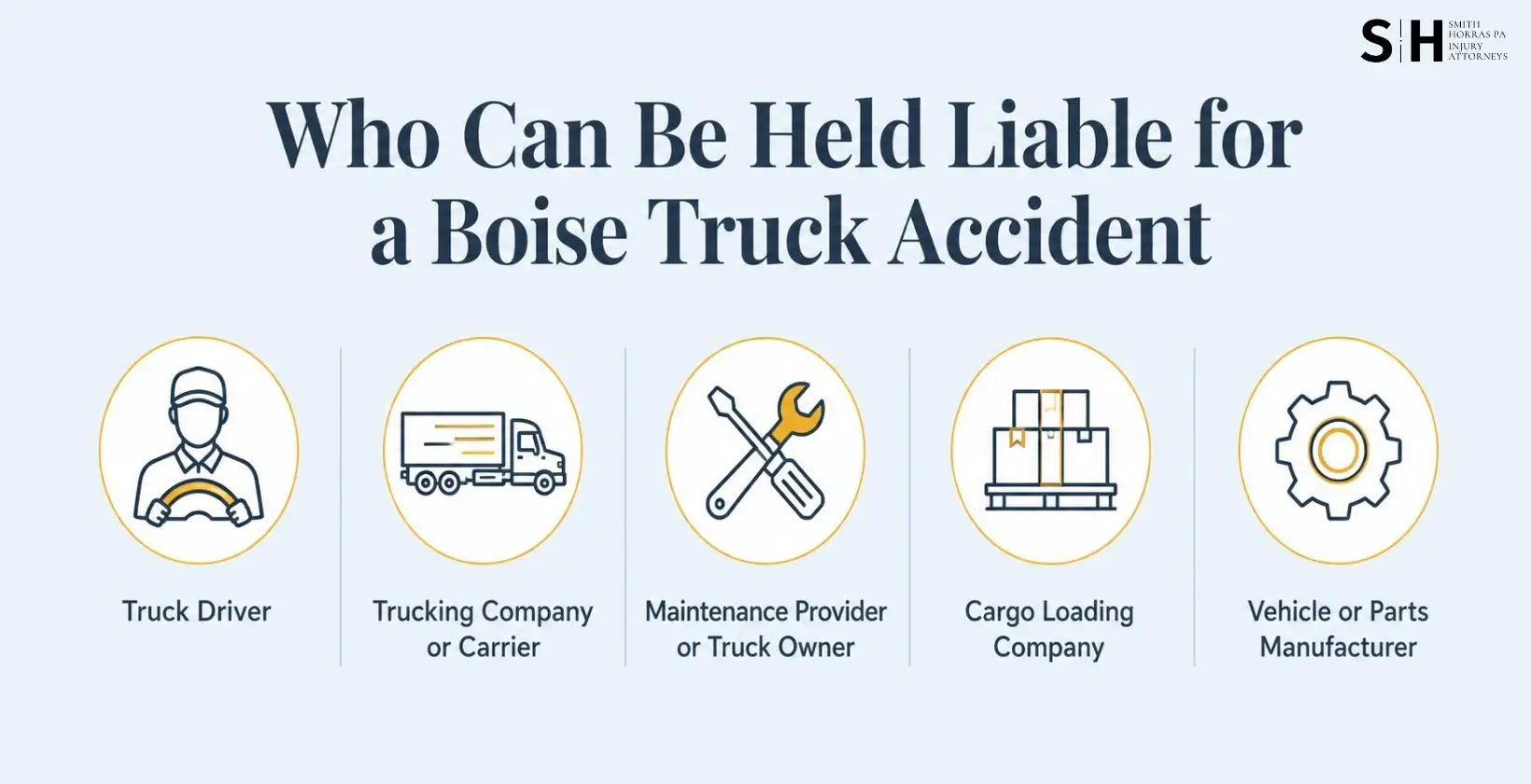
Liability on a truck claim rarely stops with the driver. Our attorneys review driver records, maintenance logs, and cargo documents to identify every party whose negligence contributed to the crash.
- Truck Driver: Drivers are liable for hours-of-service violations, distracted or impaired driving, speeding, or failing to operate the truck safely for road conditions.
- Trucking Company or Carrier: The trucking company or carrier is liable for a driver’s negligence under Idaho’s vicarious liability rules, and it can be directly liable on its own for negligent hiring, training, or dispatch decisions.
- Maintenance Provider or Truck Owner: A maintenance provider or truck owner becomes liable when negligent inspections or defective repairs cause brake failures, tire blowouts, or steering problems.
- Cargo Loading Company: Cargo loading companies are liable when improperly secured cargo contributes to a rollover, jackknife, or cargo spill crash.
- Vehicle or Parts Manufacturer: Manufacturers can be liable when a defective brake, tire, steering system, or trailer component contributes to the collision.
Naming five possible parties only matters if the claimant can prove which one caused the crash, and that proof comes from evidence, not assumption.
The Evidence That Proves Who’s Liable
Trucking companies and their insurers often have investigators at the scene within hours. We move just as fast, sending a preservation letter, sometimes called a spoliation letter, that requires the carrier to retain electronic logging device records, engine control module data, and maintenance history before routine data cycles erase them.
- Driver Logs and Hours-of-Service Records: Show whether a driver exceeded federal limits before the crash.
- Black Box and GPS Data: Capture speed, braking, and steering in the seconds before impact.
- Maintenance and Inspection Reports: Reveal skipped repairs or falsified inspection records.
- Hiring and Training Files: Expose inadequate driver screening or supervision.
This evidence is what shifts a comparative fault dispute away from the adjuster’s assumptions and toward what actually happened.
Can You Still Recover If You Were Partly at Fault?
Idaho Code § 6-801 lets you recover compensation if you are less than 50 percent at fault for the crash. Your percentage of fault reduces your recovery, and fault is generally compared against each defendant individually, though a carrier held vicariously liable for its driver’s negligence can be evaluated together with that driver’s share.
For instance, a jury values your damages at $200,000 and finds you 20 percent at fault. Your recovery is $160,000. If the same jury finds you 50 percent at fault instead, Idaho law bars recovery entirely. Once fault is settled as a percentage, that percentage applies to the total value of the claim, which is where damages come in.
How Much Is Your Truck Accident Claim Worth?
A truck accident claim’s value has two parts: economic damages you can document with a receipt or a pay stub, and non-economic damages for pain, suffering, and loss of enjoyment of life. Idaho personal injury law recognizes several distinct types of damages within each category, and a truck accident claim typically reaches higher figures in both than an ordinary car accident does.
Economic Damages
- Past and Future Medical Bills: Surgery, hospitalization, physical therapy, and any long-term monitoring your injury requires.
- Lost Income: Wages missed for every day you were unable to work following the crash.
- Reduced Future Earning Capacity: The gap between what you could earn before the crash and what you can realistically earn if the injury limits your job options going forward.
- Property Damage: Repair or replacement costs for your vehicle and any personal property damaged in the crash.
- Out-of-Pocket Costs: Prescriptions, mileage to medical appointments, and home modifications needed because of a lasting disability.
Economic damages carry a receipt, invoice, or pay stub behind them, which makes them the more straightforward half of a claim to prove. They’re also the half insurers work hardest to shrink, since adjusters routinely underestimate future costs that haven’t happened yet, particularly ongoing care and lost future income.
Non-Economic Damages
- Physical Pain: Both the immediate pain from the crash and any pain that continues during recovery or becomes permanent.
- Emotional Distress: Anxiety, trauma, or a lasting fear of driving or being near trucks again.
- Disfigurement or Scarring: Visible, lasting changes to your body caused by the crash.
- Loss of Enjoyment of Life: Activities and hobbies you could do before the crash but can no longer do, or can no longer do the same way.
- Loss of Consortium: The strain a serious injury places on a marriage or family relationship.
There is no invoice for pain, so Idaho juries and insurers rely on the severity and permanence of the injury, supported by medical testimony from your treating physicians, to assign a dollar value here. Thorough medical documentation matters just as much for this category as it does for economic damages.
Idaho Code § 6-1603 caps non-economic damages at a figure that the Idaho Industrial Commission recalculates every July 1. Confirm the current figure at iic.idaho.gov before relying on it, since it changes annually and the prior period’s number is no longer in effect. A court reduces an excessive verdict after the fact, applying the cap to a claimant’s total non-economic award regardless of how many defendants share the blame. The cap does not apply to economic damages, and it lifts entirely when a driver’s conduct was reckless, willful, or intentional, which can include a knowing hours-of-service violation.
How Long Do You Have to File a Truck Accident Claim in Idaho
You have two years from the date of a truck accident to file a personal injury lawsuit in Idaho. Idaho Code § 5-219(4) sets this deadline, and Idaho courts dismiss claims filed even one day late, regardless of how strong the evidence is.
That deadline shortens if a government-owned truck caused the crash. A crash involving a city, county, or state-owned truck triggers the Idaho Tort Claims Act’s 180-day notice requirement under Idaho Code § 6-906, and missing that 180-day window bars the claim before the two-year deadline is ever reached.
A Boise truck accident lawsuit is filed at the Ada County Courthouse, 200 W. Front St., Boise, ID 83702, within Idaho’s Fourth Judicial District.
Dealing With the Trucking Company’s Insurance Adjuster
Idaho’s mandatory minimum liability limits for a passenger vehicle are $25,000 per person, $50,000 per accident, and $15,000 for property damage. Federal law requires interstate commercial carriers to carry far higher limits, commonly $750,000 or more. Carriers fight harder on liability, not less, because of that coverage gap.
Idaho Code § 41-2502 requires your own insurer to offer uninsured and underinsured motorist coverage, known as UM/UIM, and you must reject that coverage in writing if you do not want it. UM/UIM matters on a truck claim when a driver was working outside the scope of employment, when the carrier’s policy is contested, or when the case involves an underinsured owner-operator whose personal coverage falls far short of the damages.
- Do not give a recorded statement. Recorded statements are used to lock in details before your medical picture and lost income are fully documented.
- Do not accept the first offer. Adjusters routinely open with an offer well below what an injury claim is actually worth. Ask whether that offer is even enough before you sign a release.
- Watch what you post online. Insurers and defense attorneys regularly review social media activity to challenge injury claims, so avoid discussing the crash, your injuries, or your recovery on any public account.
Attention to Detail That Sets the Case Apart
Mr. Horras is an outstanding personal injury attorney in the 208 area. He is professional, knowledgeable, and truly committed to his clients. It’s clear he takes the time to understand each case and advocate for his clients with integrity and care. Communication was clear and thoughtful, and his attention to detail really sets him apart. I would confidently recommend Mr. Horras to anyone in the Treasure Valley who needs strong, trustworthy injury representation.
Personal Injury Client
What to Do in the First 24 Hours After a Truck Accident
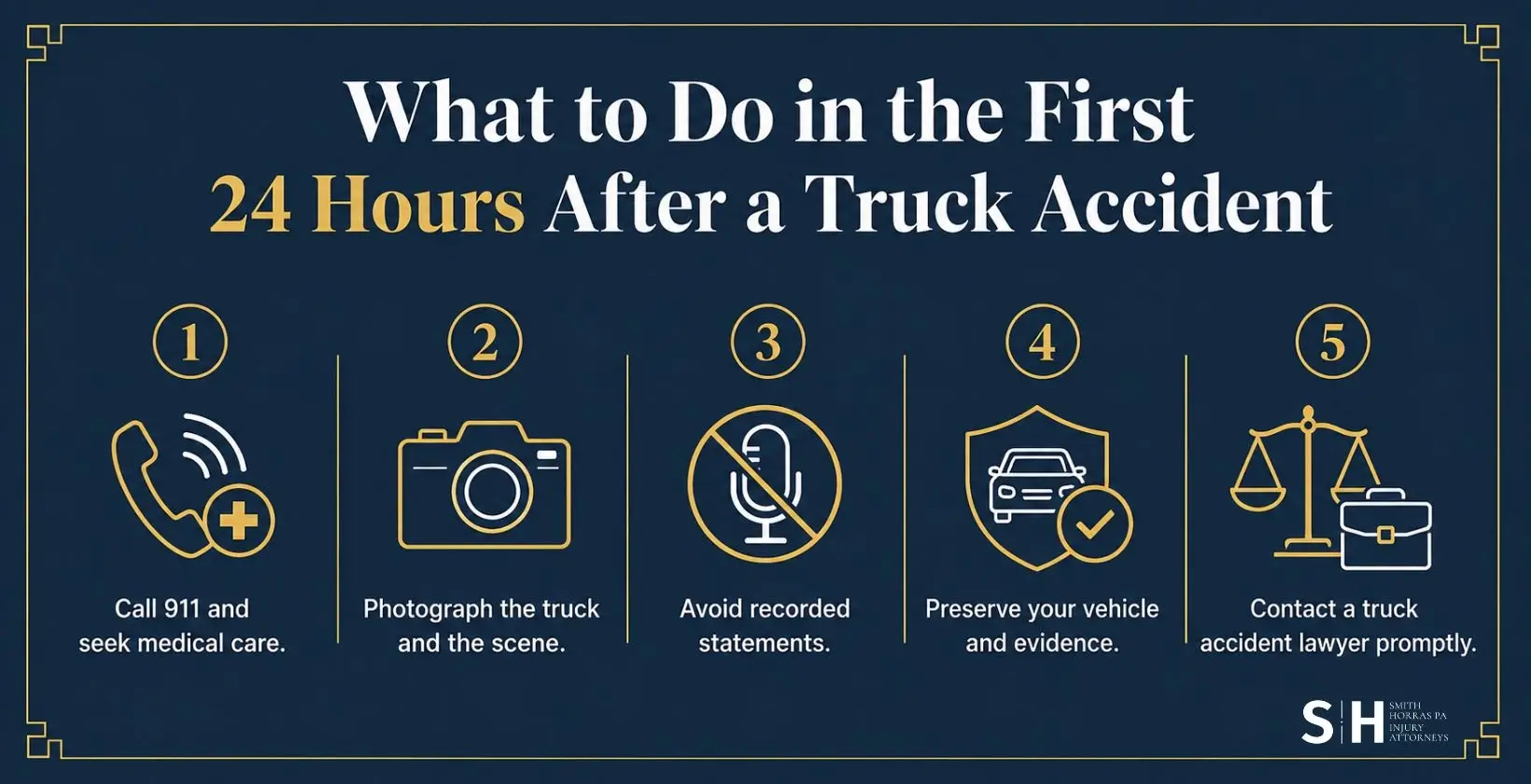
What you do in the first 24 hours of a truck accident comes down to the following five steps:
- Call 911 and seek medical care. Police reports and medical records document the crash and your injuries.
- Photograph the truck and the scene. Capture vehicle damage, skid marks, the truck’s DOT number, and company markings before the scene changes.
- Avoid recorded statements. Review what not to say to an insurance adjuster before you speak with a lawyer or give any statement to the trucking company’s adjuster.
- Preserve your vehicle and evidence. Do not repair or dispose of your vehicle before it is inspected.
- Contact a truck accident lawyer promptly. Early action preserves ELD records, ECM data, and dispatch communications before they are overwritten.
Those first steps protect the evidence. What the crash costs you over the following months and years is a separate, longer story.
The Long-Term Cost of a Serious Truck Accident
Injuries from a commercial truck crash routinely outlast the initial treatment window. Traumatic brain injuries, spinal cord damage, complex fractures, and internal organ damage can require years of follow-up care, and some permanently limit what work you can return to. Even injuries that look survivable in the emergency room, burns, amputations, skull fractures, and severe whiplash or neck and back trauma, often carry the longest recovery timelines of all.
- Future Medical Care: Surgery, physical therapy, and long-term monitoring beyond your initial treatment.
- Permanent Impairment: A documented reduction in physical function that affects daily life.
- Lost Earning Capacity: The difference between what you could earn before the crash and what you can earn afterward.
A claim built only around today’s medical bills usually undervalues these long-term costs. When a truck accident victim doesn’t survive, the claim itself changes shape entirely.
Wrongful Death Claims After a Fatal Truck Accident in Idaho
Idaho Code § 5-311 allows a surviving spouse, children, parents, or others who depended on the deceased to file a wrongful death claim. These claims can recover funeral costs, lost financial support, and loss of companionship.
The two-year filing clock still applies, but grief and probate proceedings often eat into that window faster than families expect, which makes early legal advice especially important in a fatal truck crash. Whether the case involves injury or death, the approach to building it stays the same.
How We Build Your Truck Accident Case
Every truck accident case we take on follows the same five steps.
- Free Consultation and Case Evaluation: We review the crash, your injuries, and every potentially liable party at no cost, and tell you honestly whether you have a claim worth pursuing.
- Evidence Preservation: We send a preservation letter requiring the carrier to retain ELD records, ECM data, and maintenance records before you sign anything or speak with the adjuster yourself.
- Case Investigation: We examine driver qualification files, hours-of-service records, and inspection reports to identify safety violations, while you focus on medical treatment.
- Damages Calculation: We document medical records, lost income, and future care needs to support the claim’s full value.
- Negotiation and Litigation: We prepare a demand package supported by evidence and negotiate first. Most truck accident claims settle without a trial, but we file suit and litigate when a fair settlement is not offered.
Bill Smith and Joseph Horras lead every step of it, backed by Super Lawyers recognition and Ninth Circuit appellate experience.
Frequently Asked Questions
Does It Matter If the Trucking Company Is Based Out of State?
Yes, it matters. An out-of-state carrier raises a jurisdictional question: where the carrier can be sued and whether its insurance policy fully covers an Idaho claim. We confirm both before filing, since an interstate carrier’s coverage and court exposure differ from a local driver’s.
What If the Truck Driver Was an Independent Contractor, Not an Employee?
The trucking company remains liable even when the driver is classified as an independent contractor. Idaho courts examine how much control the carrier exercised over the driver’s work, equipment, and schedule, not the label in the contract, when deciding whether that control creates carrier liability.
How Long Does a Boise Truck Accident Case Typically Take to Resolve?
Timeline depends on the severity of your injuries and whether the carrier disputes fault. The biggest factor is your own treatment, because a claim should not resolve until your doctors know what your recovery looks like. We will give you a realistic timeline for your specific case at the first consultation.
What If the Trucking Company’s Insurer Already Made a Settlement Offer?
Do not sign a settlement offer before your claim is fully documented. An early offer from the trucking company’s insurer comes before your full medical picture and lost income are calculated. Signing typically releases every other liable party from the claim, including parties not yet identified.
Can a Truck Driver and the Trucking Company Both Be Sued in the Same Case?
Yes, both can be sued in the same case. When the driver acts within the scope of employment, Idaho law lets a claim name both the driver and the carrier, and the court determines each party’s share of fault separately.
How Much Does It Cost to Hire a Boise Truck Accident Lawyer?
Hiring a Boise truck accident lawyer costs nothing upfront. Smith Horras handles truck accident claims on contingency, covering case costs upfront and collecting a fee only from an actual recovery. Learn more about how you can hire an attorney for free. If there is no recovery, the client owes no attorney fee.
Tell Us What Happened: Free Boise Truck Accident Consultation
Trucking companies begin protecting themselves within hours of a crash. Do not let the insurance company control your claim before you have spoken with an attorney who works only for you.
Smith Horras handles the full range of Idaho personal injury and accident claims, with truck accident representation concentrated in the Treasure Valley. As seasoned truck accident lawyers in Idaho, we represent injured victims throughout Boise, Garden City, Meridian, Eagle, Nampa, and Caldwell. Your first consultation is completely free, and you pay zero attorney fees unless we recover compensation for you.
Call our Garden City office at 208-697-5555 anytime, or contact us online to schedule your 100% free, no-obligation consultation. You pay no attorney fees unless we recover compensation for you.
Attorney Advertising. Prior results do not guarantee a similar outcome. Testimonials reflect individual experiences. Every case is unique, and the value of any claim depends on its specific facts. This page is general information and is not legal advice.